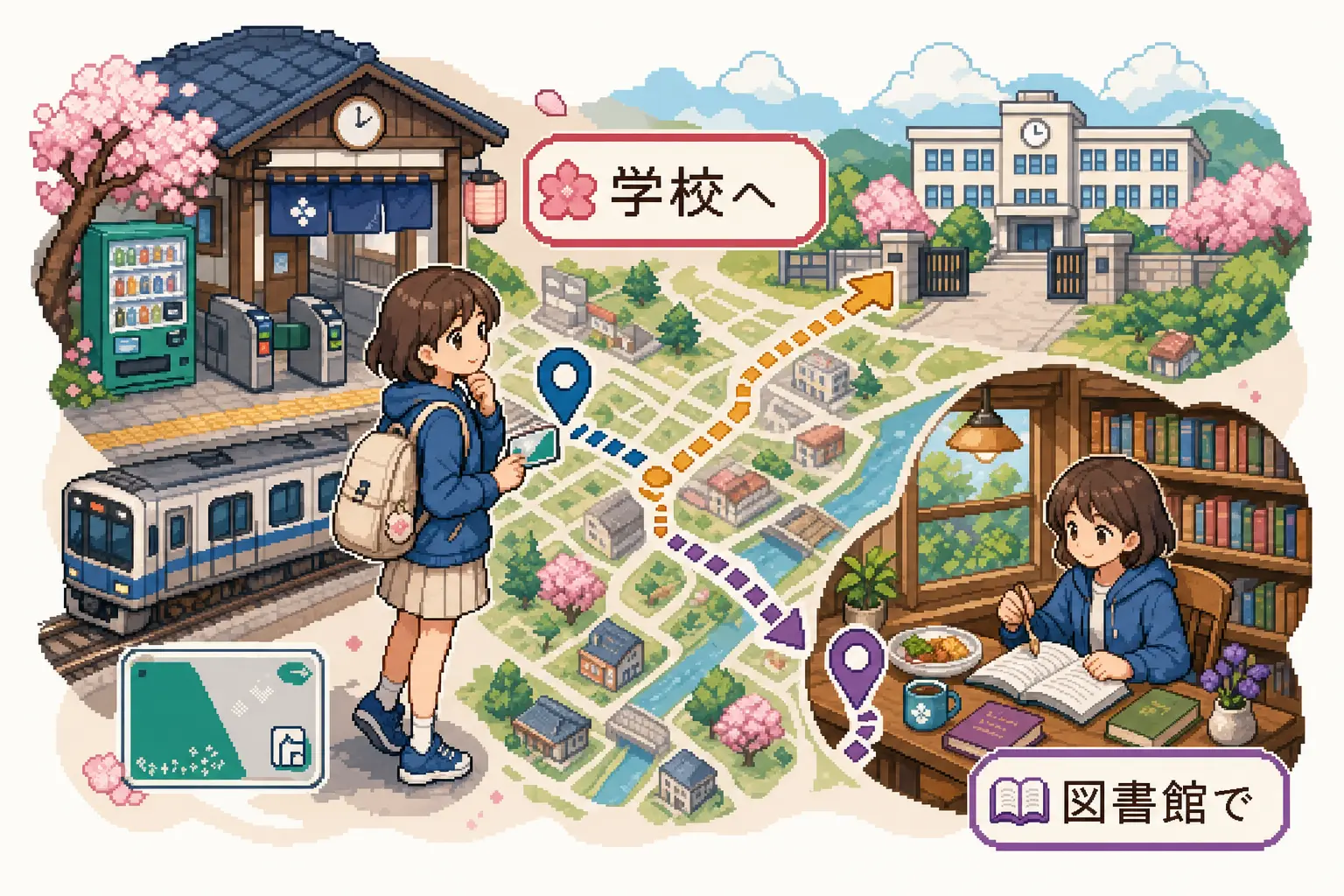
Getting Around Japan: Trains, IC Cards, and Transit Etiquette
Japan's train network is one of the most reliable in the world. Learning the basics of IC cards, transfer routes, platform etiquette, and key vocabulary will turn an intimidating system into a confident daily routine.
Who this is for
Best for first-time visitors, daily commuters, and students living in Japan
Central idea
Get an IC card on arrival, look up your transfer in advance, and stay quiet on the train — these three habits cover most situations you will encounter.
Key highlights
IC cards (Suica, Pasmo) work nationwide for trains, buses, and convenience stores.
Transfers between lines are straightforward when you read the color-coded maps.
Train etiquette is mostly about silence and not blocking doors.
A few kanji for station signs go a long way.
Japan’s public transport system works so smoothly that many visitors describe it as stress-free once they stop fighting it. The key is to learn a few core tools and habits early, then let the system do the rest.
Transportation
Getting around is simplified by unified signage, rail layouts, and digital IC cards.
Arrival Priority
Start Here
The single highest-value thing you can do on day one is buy an IC card at any major station or airport. Everything else builds from there.
IC Cards: Your Daily Transport Wallet
IC cards are reloadable contactless cards used on nearly all trains, subways, buses, and trams across Japan. The two most common are Suica (issued by JR East, linked to Tokyo) and Pasmo (linked to Tokyo Metro and private lines). Both work nationwide on almost all operators.
You load money onto the card, then tap it on the reader at the ticket gate when you enter and again when you exit. The correct fare is deducted automatically. You never need to look up prices in advance for local journeys.
Vocabulary
Suica / スイカ
Suica
IC card issued by JR East
Shaped like a penguin. Widely accepted across Japan at stations, buses, and many convenience stores and vending machines.
Vocabulary
Pasmo / パスモ
Pasmo
IC card issued by Tokyo Metro and private railways
Equally common in the Kanto area. Works identically to Suica for most purposes.
Good to Know
IC Cards Work Beyond Trains
Suica and Pasmo work at most convenience stores (7-Eleven, FamilyMart, Lawson), vending machines, and some taxis. Loading a small surplus when you top up is worth it for quick purchases throughout the day.
At the Station
チャージをお願いします。
Chaji o onegaishimasu.
I would like to top up (my IC card), please.
Say this to station staff or use the self-service machines labeled チャージ (charge) at any major station.
Reading the Station and Train System
Japanese stations are color-coded and numbered. Each subway or train line has a letter code (like G for the Ginza Line, or T for the Tozai Line in Tokyo) and each station has a number within that line. Even if you cannot read kanji quickly, you can match the code on your map to the sign above the platform.
Vocabulary
改札口
kaisatsuguchi
Ticket gate / turnstile
Where you tap your IC card to enter or exit the station.
Vocabulary
乗り換え
norikae
Transfer / change trains
Follow the norikae signs inside the station when transferring between lines.
Vocabulary
出口
deguchi
Exit
Large stations have many numbered exits. Know your exit number before you arrive.
Vocabulary
ホーム
hoomu
Platform
From English 'platform'. Each platform number and direction is clearly displayed.
Vocabulary
終電
shuuden
Last train of the night
Most lines stop between midnight and 1 a.m. Knowing the shuuden time prevents being stranded.
Vocabulary
各駅停車
kakueki teisha
Local / all-stations train
Stops at every station. Slower but useful when you are not sure which platform to use.
Asking for Help
〇〇駅へ行くには、どのホームですか。
〇〇eki e iku ni wa, dono hoomu desu ka.
Which platform should I use to go to [station name]?
Replace 〇〇 with your destination station name. Station staff are generally very patient with travelers.
Checking Your IC Card Balance
残高を確認したいのですが。
Zandaka o kakunin shitai no desu ga.
I would like to check my balance.
You can also check at any green self-service machine or at the card reader machines near the exit.
Shinkansen: Long-Distance Bullet Trains
The Shinkansen (新幹線) is Japan’s high-speed rail network. It connects major cities like Tokyo, Osaka, Kyoto, Hiroshima, and Fukuoka. IC cards generally do not work for Shinkansen fares — you need to purchase a separate ticket or use a Japan Rail Pass if you have one.
Shinkansen Note
Reserved vs. Unreserved Seats
Shinkansen trains have both reserved (指定席) and unreserved (自由席) seating. Unreserved is cheaper and fine for shorter routes but can fill during peak travel. Reserve a seat for busy seasons.
Vocabulary
指定席
shiteiseki
Reserved seat
Your seat number is printed on the ticket. Sit only in your assigned seat.
Vocabulary
自由席
jiyuuseki
Unreserved / free seat
Sit in any open seat in the designated unreserved carriages. Board from the end of the queue line.
Train Etiquette
Japan’s trains are quiet by default. There are no rules posted on every wall, but the behavior of other passengers tells you what is expected. Most of it comes down to keeping to yourself and not disturbing others.
Quick Checklist
Do
Keep your phone on silent mode. Texting is fine; calling is not.
Stand in the queue line marked on the platform floor before the train arrives.
Move into the center of the carriage if there is space.
Give up the priority seats (優先席) near the doors to elderly passengers, pregnant riders, and people with disabilities.
Use headphones at a low volume if you are listening to something.
Don’t
Do not talk on the phone inside the train.
Do not eat or drink on local trains. Long-distance express trains are an exception.
Do not stand in front of the doors when they are about to open.
Do not spread your bag across a spare seat during busy hours.
Do not rush to board before passengers have completely exited.
If You Miss Your Stop
乗り越してしまいました。
Norikoishite shimaimashita.
I went past my stop.
Say this to the station attendant at the exit. They can usually sort out the fare difference quickly.
Quick Reference: Key Station Signs
Most major signs in Tokyo, Osaka, and Kyoto are bilingual or use romaji alongside Japanese. Outside tourist-heavy areas, kanji knowledge helps.
Vocabulary
入口
iriguchi
Entrance
Often posted above the ticket gate entrance side.
Vocabulary
精算機
seisanki
Fare adjustment machine
Use this if your IC card balance was too low when you exited. Top up and tap again.
IC Card Habits
Do
Keep a small buffer (around ¥1000) on your IC card at all times.
Register your IC card online to protect the balance if you lose it.
Use the IC card reader LCD screen to see your balance after each tap.
Don't
Do not let the balance drop to zero before a journey — the gate will reject you.
Do not try to tap the exit gate before all passengers ahead of you have cleared it.
Do not assume your IC card works on every rural bus — some smaller systems are cash-only.
Precision Note
Schedules, fares, and IC card rules vary by region and operator. Always check the official route planner (such as Google Maps or Hyperdia) for your specific journey, especially for long-distance travel on Shinkansen or rural lines.
Source Links
These are the source pages used to ground this guide.