Shopping in Japan is usually smooth, but the small details matter: passport-based tax-free procedures, limited tipping culture, and business hours that vary by region.
Who this is for
Best for visitors and new arrivals
Central idea
Tax-free shopping can save money, but you need your passport and should not assume every store handles it the same way.
Key highlights
Carry your passport if you plan to shop tax-free.
Do not tip in ordinary stores, restaurants, or taxis.
Urban shops often run roughly 10:00 a.m. to 8:00 p.m.
Convenience stores (コンビニ) are open 24/7 and sell almost everything you need daily.
At checkout, staff will ask if you need a bag and whether you have a points card.
Japan is easier to shop in than many first-time visitors expect, but the rules are procedural. The key is understanding where tax exemption applies, how payment habits differ, and when stores actually open and close.
Shopping
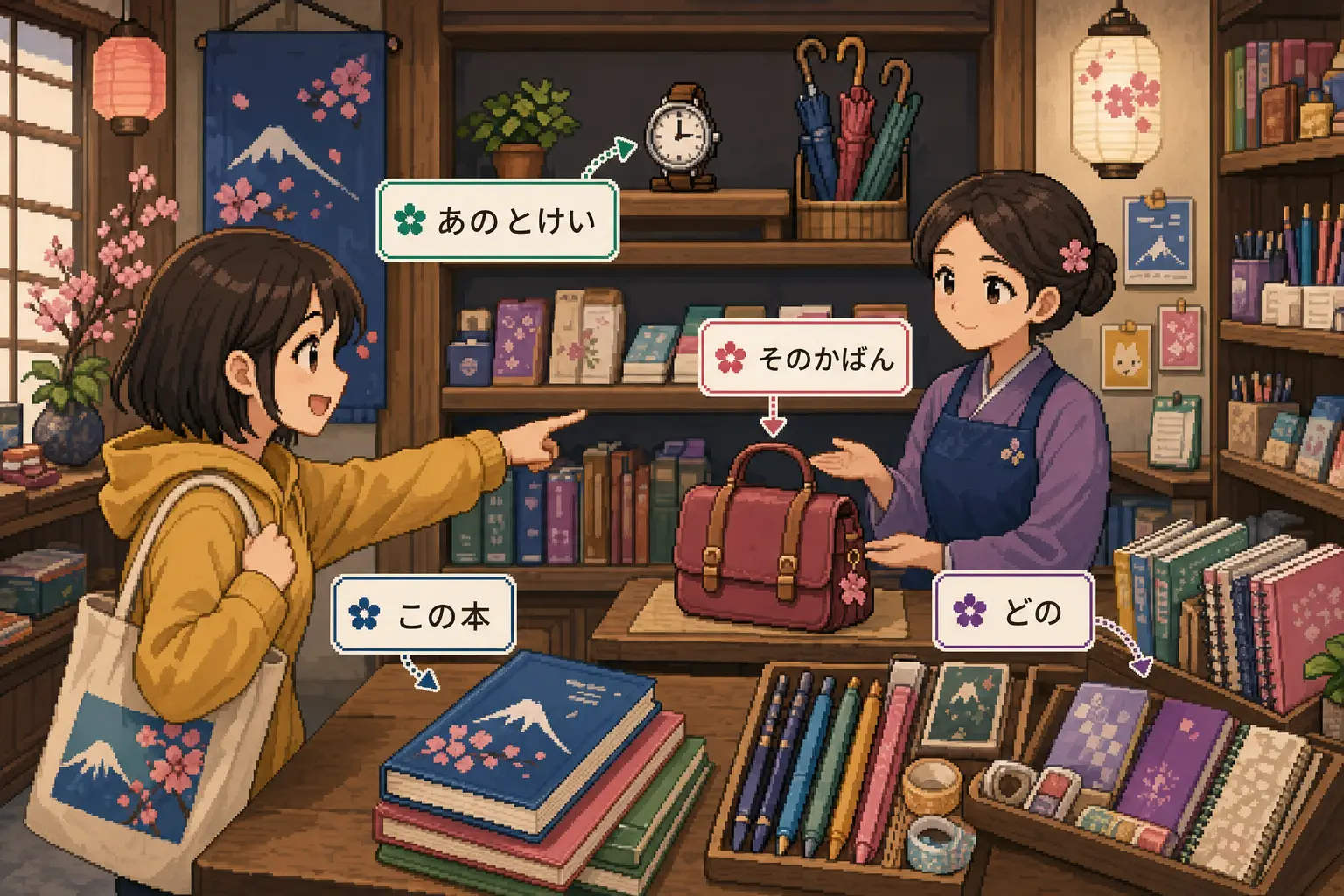
Pointing and using demonstrative terms (this, that) is the core of retail communication.
Quick Read
Shopping Rule Of Thumb
Do not assume the store works like home. In Japan, the right move is usually to ask politely and follow the store’s own process.
Types of Stores
Japan has a distinctive retail landscape with several store types you will not find elsewhere or that work differently than you might expect.
Vocabulary
コンビニ
konbini
Convenience store
7-Eleven, FamilyMart, and Lawson are open 24/7. They sell food, medicine, toiletries, ATM services, print services, and bill payments. Essential to daily life in Japan.
Vocabulary
百均 / 百円ショップ
hyakkin / hyakuen shoppu
100-yen shop
Everything costs ¥100–¥110. Daiso and Seria are the big chains. You can furnish an apartment and stock a kitchen from these stores.
Vocabulary
デパ地下
depachika
Department store basement food hall
The basement floor of Japanese department stores holds an extraordinary range of premium prepared food, sweets, bento boxes, and fresh produce.
Vocabulary
ドンキ / ドン・キホーテ
donki / don kihoote
Don Quijote discount chain
A multi-floor discount store open late or 24 hours. Sells electronics, clothes, food, cosmetics, and much more at low prices. Excellent for tourist shopping.
Vocabulary
薬局 / ドラッグストア
yakkyoku / doraggu sutoa
Pharmacy / drugstore
Sells medicine, cosmetics, supplements, and many convenience-store items, often cheaper. Popular destinations for skincare shopping.
Vocabulary
スーパー
suupaa
Supermarket
Regular grocery store. Great for buying fresh food and daily necessities. Prices drop significantly in the evening for prepared meals near closing.
Daily Life
Konbini Are More Useful Than You Think
Japanese convenience stores go far beyond snacks. You can pay bills, withdraw cash from international ATMs, print documents, buy event tickets, send packages, and eat a surprisingly good meal — all at the same counter.
Tax-Free Shopping Is Real, But It Is Not Automatic
JNTO notes that tax exemption can apply to both general goods and many consumable goods, but only under specific conditions. Not every store offers the service, and the process can differ by retailer.
In practical terms, keep your passport with you, look for tax-free counters or signs, and ask before assuming the discount will be applied at checkout.
Vocabulary
免税
menzei
Tax-free / tax exemption
Look for this on signs and counters when shopping. A dedicated menzei counter is common in large department stores and electronics shops.
Vocabulary
パスポート
pasupoto
Passport
Bring the real passport, not just a copy, if you expect tax-free processing.
Bring your passport, not just a photocopy.
Check whether the store processes tax-free purchases on the spot or at a dedicated counter.
As of April 2025, JNTO notes that tax-free shopping does not apply if you send items by international parcel.
At the Checkout Counter
Japanese checkout interactions follow a recognizable script. Staff will typically ask if you have a points card and whether you need a bag. Knowing the expected phrases helps the interaction go smoothly for everyone.
You Will Often Hear This First
ポイントカードはお持ちですか。
Pointo kaado wa omochi desu ka.
Do you have a points card?
Common at supermarkets, drugstores, and chain shops. Say 大丈夫です (daijobu desu) or 持っていません (motte imasen) if you do not have one.
About the Bag
レジ袋はご利用ですか。
Rejibukuro wa goriyou desu ka.
Would you like a bag?
Since 2020, plastic bags in Japan are no longer free. Staff will often ask before adding one. Say 大丈夫です to decline.
Asking for a Receipt
レシートをお願いします。
Reshiito o onegaishimasu.
The receipt, please.
Receipts are usually offered automatically in Japan, but this phrase is useful if yours was missed.
Vocabulary
ポイントカード
pointo kaado
Points card / loyalty card
Many Japanese chains have their own points systems. Free to join at checkout, and they add up quickly.
Vocabulary
レジ袋
rejibukuro
Plastic shopping bag
Charged per bag since the 2020 fee introduction. Carrying a small reusable bag saves money and is the norm.
Vocabulary
お釣り
otsuri
Change (returned money)
Cash change is handed back carefully with two hands or placed on a small tray at the counter. Receive it with similar care.
Payment Tip
Handling Cash With Care
Cash is exchanged neatly in Japan. Many registers have a small tray on the counter — you place your payment there rather than handing it directly to the cashier. They will return change the same way. Following this rhythm shows awareness of local practice.
Payment Habits Are Mixed, Not Purely Cash-Only
Japan is no longer accurately described as entirely cash-only. JNTO states that credit cards are usually accepted in many shops, restaurants, and taxis in major cities, but this becomes less dependable in smaller areas and older businesses.
It is still smart to carry some cash, especially for local shops, shrines, small restaurants, market stalls, and rural travel.
Use cards confidently in major urban areas.
Keep cash for smaller businesses and transport edge cases.
IC cards (Suica, Pasmo) work at most convenience stores and many vending machines.
Do not leave a tip unless you are in an unusual private-guide situation.
Shop Timing Affects The Experience
JNTO gives a practical baseline: urban shops often run about 10:00 a.m. to 8:00 p.m., while rural shops may close earlier. Convenience stores and some chain businesses operate around the clock.
Crowds and availability also change sharply around New Year, Golden Week, and Obon, so the smartest shopping strategy is to avoid assuming normal hours during major holiday periods.
Vocabulary
営業時間
eigyo jikan
Business hours
A helpful phrase when checking store signs or searching online before you go.
Vocabulary
定休日
teikyuubi
Regular closing day
Many smaller shops have one day per week when they close. Check before making a special trip.
Shop earlier in rural areas.
Use convenience stores for late-night essentials.
Book and buy earlier during major holiday seasons.
Sizing in Japan
Japanese sizing often runs smaller than European or American equivalents. This applies most noticeably to clothing, shoes, and hats. Many international chains now offer size conversions on their labels, but for domestic brands and vintage shops, expect to compare against your actual measurements rather than your usual size letter.
Asking About Your Size
Mサイズはありますか。
Emu saizu wa arimasu ka.
Do you have a medium size?
Replace M with S (ess), L (eru), or XL (ékusueru) as needed. Many staff will also guide you to the size area if you hand them your item.
Quick Checklist
Quick Checklist
Do
Carry your passport if you plan to use tax-free shopping.
Keep both card and cash available for different store types.
Say 大丈夫です to decline a plastic bag at the register.
Bring a reusable bag to avoid paying for plastic bags.
Check business hours (営業時間) before assuming a store will still be open.
Use convenience stores for ATM access, printing, and bill payments as well as shopping.
Don’t
Do not assume tax-free processing is automatic everywhere.
Do not rely on tipping as a normal shopping or dining habit.
Do not assume holiday periods follow ordinary opening patterns.
Do not hand cash directly to a cashier if there is a tray on the counter — use the tray.
Do not assume Japanese sizing matches your home-country size labels.
Precision Note
Store policies, tax-free procedures, and accepted payment methods can vary. Ask staff directly instead of relying on assumptions from other countries.
Source Links
These are the source pages used to ground this guide.