Causative Voice (させる)
Learning objectives
- Conjugate verbs into the causative form.
- Express 'making' someone do an action (force/command).
- Express 'letting/allowing' someone to do an action (permission).
- Combine the causative form with giving/receiving verbs (〜せていただく).
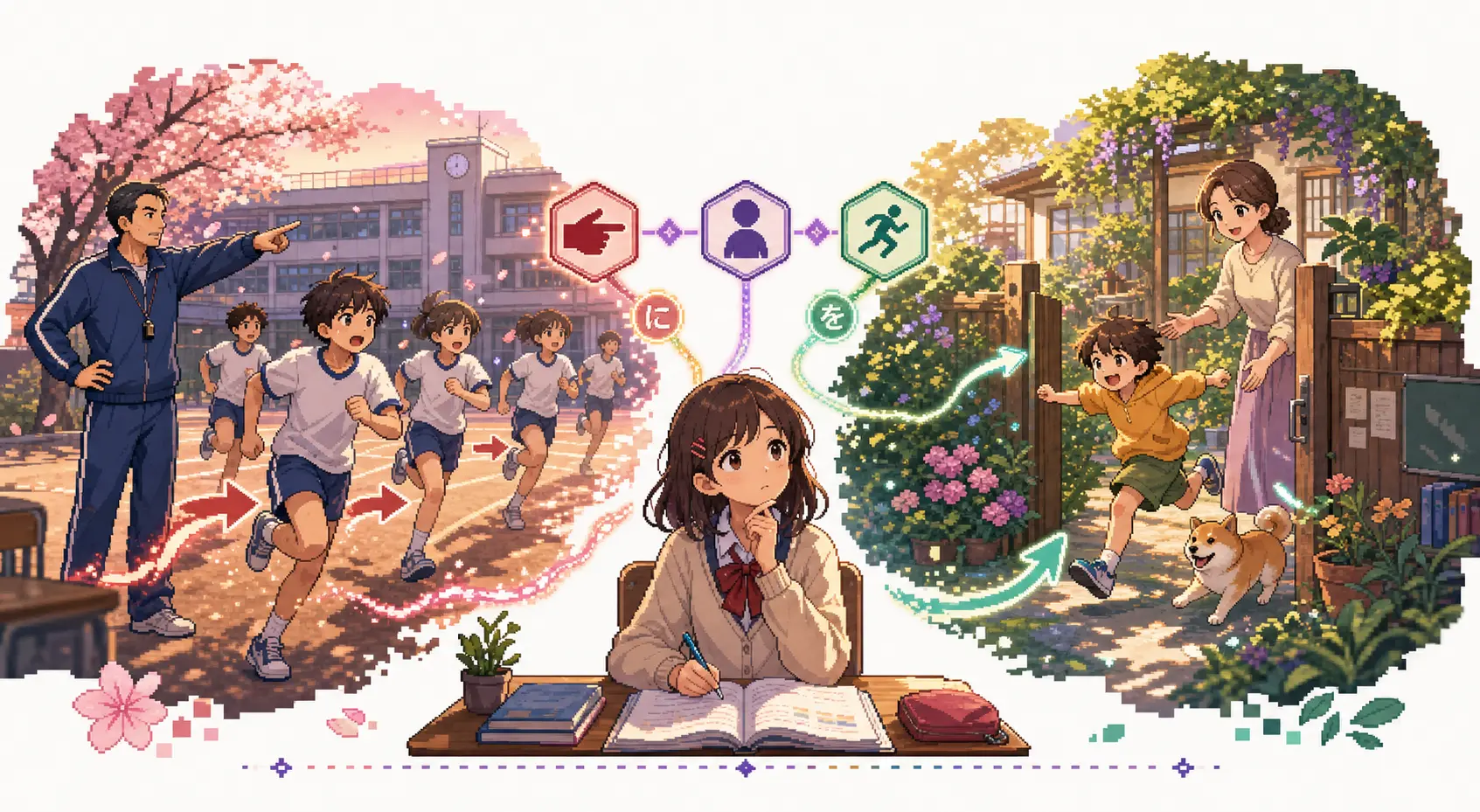
In Japanese, when someone causes someone else to do an action—whether by forcing them (“The teacher made the students run”) or permitting them (“The mother let the child play”)—you use the Causative Form (使役形 - shiekikei). Let’s learn how to conjugate and use this authoritative structure.
1. Conjugating the Causative Form
The conjugation rules for the causative form are very similar to the passive form, but we use せる instead of れる.
Group 1 (U-Verbs)
Change the final 〜u sound to the 〜a sound, and add せる (seru).
- 書く (kaku) ➔ 書かせる (kakaseru - to make/let write)
- 飲む (nomu) ➔ 飲ませる (nomaseru - to make/let drink)
- 待つ (matsu) ➔ 待たせる (mataseru - to make/let wait)
- 手伝う (tetsudau) ➔ 手伝わせる (tetsudawaseru - to make/let help)
Group 2 (Ru-Verbs)
Drop the る and add させる (saseru).
- 食べる (taberu) ➔ 食べさせる (tabesaseru - to make/let eat)
- 見る (miru) ➔ 見させる (misaseru - to make/let see)
Group 3 (Irregular Verbs)
- 来る (kuru) ➔ 来させる (kosaseru - to make/let come)
- する (suru) ➔ させる (saseru - to make/let do)
2. Making vs. Letting (Force vs. Permission)
The causative form has two main meanings: Force/Command (“I made him do it”) and Permission (“I let him do it”). The translation entirely depends on the context!
Both structures use the exact same grammar pattern. The key is knowing if the action is inherently undesirable (Force) or desirable (Permission).
A. Intransitive Verbs (No Direct Object)
When using verbs that don’t take a direct object (like run, go, cry), the person who is made/allowed to do the action is marked with を.
Pattern: [Director] は [Cast Member] を [Intransitive Causative]
先生は学生を走らせました。
sensei wa gakusei o hashirasemashita.
The teacher made the students run. (Force)
母は子供を公園で遊ばせました。
haha wa kodomo o kouen de asobasemashita.
The mother let the child play in the park. (Permission)
コーチは選手たちを休ませました。
koochi wa senshu-tachi o yasumasemashita.
The coach let the players rest. (Permission)
B. Transitive Verbs (Takes a Direct Object)
To avoid having two を particles in one sentence, when the verb takes a direct object, the person made/allowed to do the action is marked with に.
Pattern: [Director] は [Cast Member] に [Direct Object] を [Transitive Causative]
父は弟に部屋の掃除をさせました。
chichi wa otouto ni heya no souji o sasemashita.
My father made my younger brother clean the room. (Force)
私は妹に私のパソコンを使わせました。
watashi wa imouto ni watashi no pasokon o tsukawasemashita.
I let my younger sister use my computer. (Permission)
先生は学生に辞書を使わせました。
sensei wa gakusei ni jisho o tsukawasemashita.
The teacher let the students use dictionaries. (Permission)
[!TIP] Think of a movie set. The speaker is the Director (は). The person performing the action is the Cast Member (に/を). The Director causes the Cast Member to act!
3. Asking for Permission: 〜せてください
When you want to ask someone for permission to do something (literally: “Please let me do…”), you combine the causative form 〜せて with ください.
This is a very polite and common way to offer to do something or ask to be excused.
means Please let me do [verb]. / Allow me to do [verb].
Formation
Verb-sasete + kudasai
今日は早く帰らせてください。
kyou wa hayaku kaerasete kudasai.
Please let me go home early today.
写真を撮らせてください。
shashin o torasete kudasai.
Please allow me to take a picture.
私にその仕事をやらせてください。
watashi ni sono shigoto o yarasete kudasai.
Please let me do that job.
4. Cultural Insight: Parent-Child Dynamics and Authority
In Japanese society, the causative form is frequently used within families, especially from parents to children. It reflects the hierarchical nature of the Japanese family structure.
- Education and Discipline: Parents often use the “Force” meaning to ensure children fulfill their responsibilities, such as
勉強させる(making them study) or手伝わせる(making them help). - Encouraging Independence: Conversely, “Permission” is used to foster growth, like
好きなことをさせる(letting them do what they like) or一人で旅行させる(letting them travel alone).
Understanding the relationship between the speaker (the “Director”) and the performer (the “Cast Member”) is crucial. Using the causative form toward a superior (like your boss) without adding polite expressions like 〜てください or 〜ていただく can sound extremely rude and bossy. Always consider the social hierarchy before “causing” someone to act!
In extremely polite business settings, you will hear 〜せていただきます (I humbly receive the favor of you letting me do…), which is practically a staple of Japanese corporate emails. Example: 休ませていただきます - “I will (receive the favor of you letting me) take a day off.”
Contextual Dialogues
Let’s see how Tanaka and Suzuki use the causative form in the workplace.
鈴木さん、今日も忙しそうですね。
Suzuki-san, kyou mo isogashisou desu ne.
Suzuki-san, you look busy today too.
ええ。課長にこの長いレポートを書かせたんです。
Ee. Kachou ni kono nagai repooto o kakaseta n desu.
Yes. The section manager made me write this long report.
あ、課長が書かせたんですか。それは大変ですね。
A, kachou ga kakaseta n desu ka. Sore wa taihen desu ne.
Oh, the manager made you write it? That's tough.
しかも、今日は早く帰らせてくれません。
Shikamo, kyou wa hayaku kaerasete kuremasen.
Moreover, he won't let me go home early today.
ところで、明日の会議ですが、私に計画を説明させてください。
Tokorode, ashita no kaigi desu ga, watashi ni kousou o setsumei sasete kudasai.
By the way, regarding tomorrow's meeting, please let me explain the plan.
わかりました。では、説明は田中さんに任せます。
Wakarimashita. Dewa, setsumei wa Tanaka-san ni makasemasu.
Understood. Then I will leave the explanation to you.
お母さん、今からゲームをしてもいい?
Okaasan, ima kara geemu o shite mo ii?
Mom, can I play games now?
だめよ。先に弟に宿題のためにパソコンを使わせなさい。
Dame yo. Saki ni otouto ni shukudai no tame ni pasokon o tsukawasenasai.
No. First, you have to let your younger brother use the computer for his homework.
えー、また使わせるの?じゃあ、友達と公園に行かせてください。
Ee, mata tsukawaseru no? Jaa, tomodachi to kouen ni ikasete kudasai.
Eh? He's using it again? Then, please let me go to the park with my friends.
宿題が終わったら、行かせてあげるわ。
Shukudai ga owattara, ikasete ageru wa.
If you finish your homework, I'll let you go.
わかった!すぐやるよ!
Wakatta! Sugu yaru yo!
Okay! I'll do it right away!
Chapter Summary
- 1Causative verbs mean 'to make' or 'to let' someone do something.
- 2Conjugation ends in せる (Group 1) or させる (Group 2 and Irregular).
- 3For intransitive verbs, mark the person doing the action with を.
- 4For transitive verbs, mark the person doing the action with に to avoid double を.
- 5Use 〜せてください to ask for permission: 'Please let me...'
Knowledge Check
Test your understanding of the Causative Form!
What is the causative form of the Group 1 verb '読む' (yomu - to read)?
Practice Quiz
What is the causative form of the Group 1 verb '読む' (yomu - to read)?
- 読ませる
- 読みせる
- 読めせる
- 読むさせる
What is the causative form of '食べる' (taberu - to eat)?
- 食べせる
- 食べらせる
- 食べさせる
- 食べまれる
Translate: 'The teacher made the students write kanji.'
- 先生は学生が漢字を書かえました。
- 先生は学生に漢字を書かせました。
- 先生は学生を漢字を書かせました。
- 学生は先生に漢字を書かせました。
Which particle is used for the person doing the action if the verb is INTRANSITIVE (like run, wait, go)?
- は
- に
- を
- が
Translate: 'Please let me think about it.'
- 考えさせます。
- 考えさせてください。
- 考えさせてもいいですか。
- 考えてください。
What is the causative form of the irregular verb '来る' (kuru - to come)?
- きさせる
- こさせる
- くるせる
- こらせる
In the sentence '母は子供に野菜を食べさせた', what is the meaning?
- The mother ate the child's vegetables.
- The child let the mother eat vegetables.
- The mother made/let the child eat vegetables.
- The child made the mother eat vegetables.
What is the causative form of '待つ' (matsu - to wait)?
- 待たせる
- 待ちゃせる
- 待ちせる
- 待たさせる
How do you say 'Please let me do it' using the causative form?
- 私がさせます
- 私にさせてください
- 私がするください
- 私にしてあげます
What does '休ませていただきます' mean in business Japanese?
- You will take a day off.
- I am forcing you to take a day off.
- I humbly receive the favor of you letting me take a day off (I am taking a day off).
- Please do not take a day off.
Which is biologically correct grammar: '犬に走らせた' or '犬を走らせた'?
- 犬に走らせた
- 犬を走らせた
- Both are equally correct.
- Neither is correct.
If a friend says '少しゲームを遊ばせて!', what do they mean?
- Let's play a game!
- Please let me play the game (a little)!
- I made someone play the game!
- Do you want to play?
What is the causative form of '行く' (iku - to go)?
- 行かせる
- 行きせる
- 行かさせる
- 行こせる
In the dialogue, Tanaka says '私に計画を説明させてください'. Why?
- He is forcing Suzuki to explain.
- He is asking for permission to explain the plan himself.
- He refuses to explain.
- He wants to listen to the explanation.
Can the causative form be used for both 'force' and 'permission'?
- No, it only means 'force'.
- No, it only means 'permission'.
- Yes, the context and relationship dictate whether it means force or permission.
- Only Group 1 means force, and Group 2 means permission.
Applied review
Use what you learned
Focus: Causative form. Try the task before revealing the model.
Produce the Japanese sentence, then compare it with the model answer.
1.Ask politely to be allowed to explain.
Causative form in context
N4 mini-reading
- Which action was required and which was allowed?