Passive Voice (られる)
Learning objectives
- Conjugate verbs into the passive form.
- Use the Direct Passive for actions done to a person or object.
- Understand the Indirect/Suffering Passive, a uniquely Japanese concept.
- Properly use the particle に to mark the ‘doer’ of the passive action.
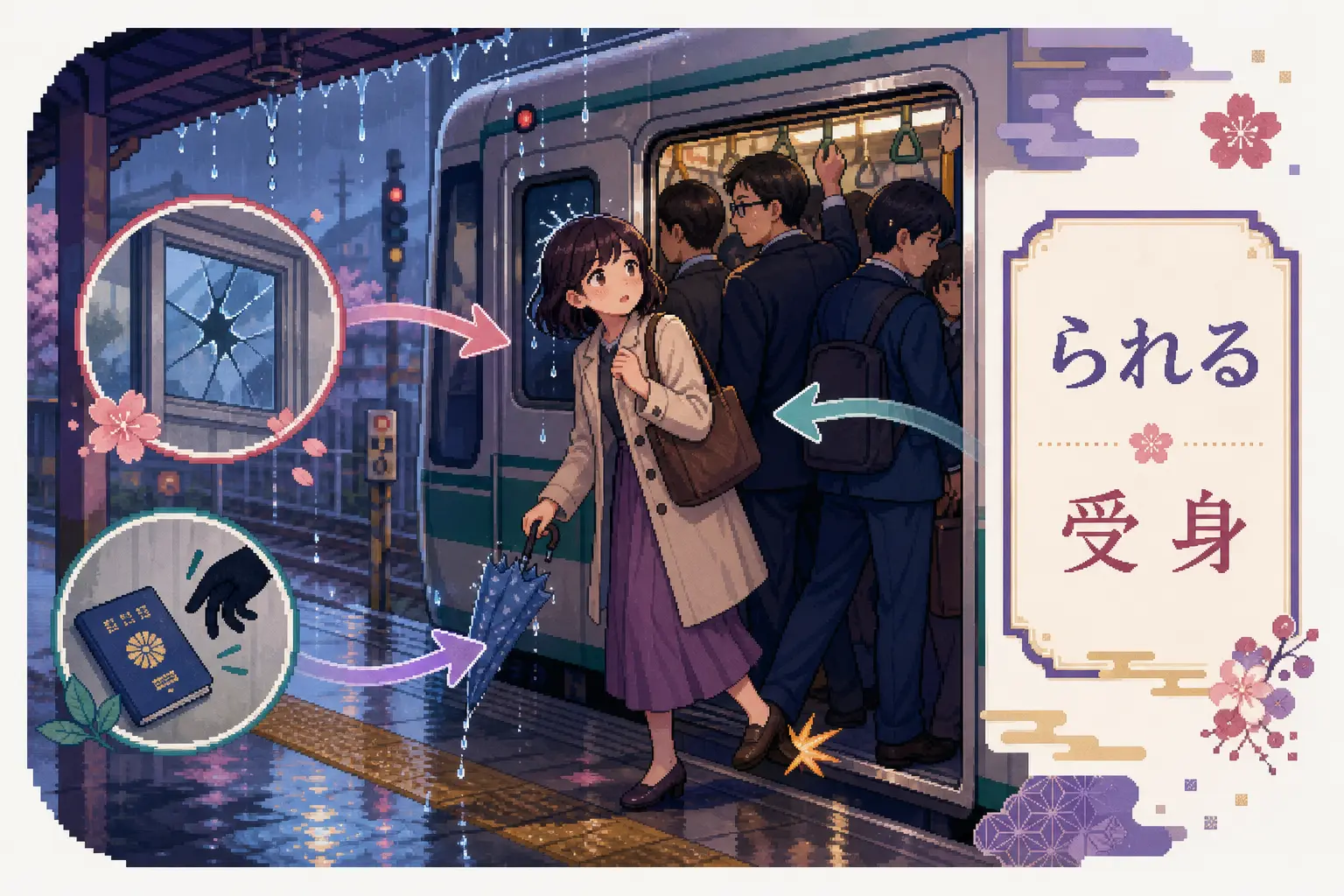
In English, the passive voice shifts focus from who did the action to who received the action (“The dog bit me” ➔ “I was bitten by the dog”). Japanese has a similar function, but it also has a unique psychological layer: the Indirect Passive, often called the “Suffering Passive”. It expresses how someone else’s action negatively affected you!
1. Conjugating the Passive Form (受身形 - Ukemikei)
First, let’s look at how to conjugate verbs into the passive voice. The rules are very similar to creating the negative (Nai-form) and adding a suffix.
Group 1 (U-Verbs)
Change the final 〜u sound to the 〜a sound, and add れる (reru).
- 叱る (shikaru - to scold) ➔ 叱られる (shikarareru - to be scolded)
- 踏む (fumu - to step on) ➔ 踏まれる (fumareru - to be stepped on)
- 呼ぶ (yobu - to call) ➔ 呼ばれる (yobareru - to be called)
- 使う (tsukau - to use) ➔ 使われる (tsukawareru - to be used) (Note: u becomes wa)
Group 2 (Ru-Verbs)
Drop the る (ru) and add られる (rareru).
(Note: This is identical to the Potential Form for Group 2! You must judge by context).
- 見る (miru - to see) ➔ 見られる (mirareru - to be seen)
- 食べる (taberu - to eat) ➔ 食べられる (taberareru - to be eaten)
Group 3 (Irregular Verbs)
- 来る (kuru - to come) ➔ 来られる (korareru - to be come [upon])
- する (suru - to do) ➔ される (sareru - to be done)
2. Direct Passive (直接受身)
The Direct Passive works just like English. The person or thing that receives the action becomes the subject/topic (は or が), and the person who did the action is marked with に (by).
means Receiver is [verb]ed by the Doer.
Formation
Passive Verb Conjugation
私は先生に褒められました。
watashi wa sensei ni homeraremashita.
I was praised by the teacher.
泥棒にパスポートを盗まれました。
dorobou ni pasupooto o nusumaremashita.
My passport was stolen by a thief.
If the passive sentence is about a historical fact, a building, an invention, or an event, the “doer” is usually marked with によって instead of just に.
このビルは有名な建築家によって建てられました。
kono biru wa yuumei na kenchikuka ni yotte tateraremashita.
This building was built by a famous architect.
3. Indirect “Suffering” Passive (間接受身)
This is a concept deeply embedded in Japanese psychology. You can use the passive voice even when an action was not done directly to you, but the action broadly inconvenienced or annoyed you.
In this structure, you (the speaker) are the subject (私は), the person who caused the problem is marked with に, and the action they took is in the passive voice.
means I was negatively affected/annoyed by the Doer doing [verb].
Formation
Subject + に + Passive Verb
私は隣の人にタバコを吸われました。
watashi wa tonari no hito ni tabako o suwaremashita.
I suffered from the person next to me smoking (My neighbor smoked, and it bothered me).
夜中、赤ちゃんに泣かれました。
yonaka, akachan ni nakaremashita.
I was inconvenienced by the baby crying in the middle of the night.
雨に降られて、服が濡れました。
ame ni furarete, fuku ga nuremashita.
I was caught in the rain, and my clothes got wet (The rain fell, inconveniencing me).
[!WARNING] You cannot use the indirect passive for positive actions. For example, if your baby crying made you happy, you would not say “赤ちゃんに泣かれました”. The suffering passive is strictly for reporting complaints or hardships.
4. Cultural Insight: The Social Context of Passive Voice
In Japanese society, maintaining harmony (wa) is extremely important. The passive voice is often used as a linguistic tool to avoid placing direct blame or being too confrontational.
By using the passive voice, the speaker can describe an event without directly pointing a finger at someone as the “actor.” For example, instead of saying “You broke this window,” a Japanese speaker might say 「窓が壊されました」 (The window was broken), which subtly shifts the focus away from the person who did it.
Furthermore, the Suffering Passive allows people to express their feelings of being inconvenienced without directly complaining about the person’s character. It’s a way to say, “I am in a difficult situation because of this action,” which is more socially acceptable than saying, “You are annoying me.”
Contextual Dialogues
1. A Bad Day (最悪な一日)
Listen to how Tanaka and Suzuki use the passive voice to complain about their day.
鈴木さん、ひどい顔ですね。どうしたんですか。
Suzuki-san, hidoi kao desu ne. Dou shita n desu ka.
Suzuki, you look terrible. What happened?
実は、今日は最悪でした。まず、電車の中で足を踏まれました。
Jitsu wa, kyou wa saiaku deshita. Mazu, densha no naka de ashi o fumaremashita.
To be honest, today was awful. First, someone stepped on my foot on the train.
それは痛いですね…。
Sore wa itai desu ne...
That is painful...
そして、雨に降られて、カバンが濡れました。さらに、会社で課長に叱られました。
Soshite, ame ni furarete, kaban ga nuremashita. Sarani, kaisha de kachou ni shikararemashita.
Then, I was caught in the rain, and my bag got wet. Furthermore, I was scolded by the section manager at the company.
2. Praised by the Teacher (先生に褒められた)
Positive use of direct passive (though less common than suffering passive, it’s still used!).
田中さん、今日はとても嬉しいです!
Tanaka-san, kyou wa totemo ureshii desu!
Tanaka, I'm very happy today!
どうしたんですか。
Dou shita n desu ka.
What happened?
日本語の授業で、先生に褒められたんです。
Nihongo no jugyou de, sensei ni homerareta n desu.
I was praised by the teacher during the Japanese class.
すごいですね!毎日一生懸命勉強していましたからね。
Sugoi desu ne! Mainichi isshoukenmei benkyou shite imashita kara ne.
That's great! It's because you've been studying hard.
Chapter Summary
- 1Group 1 passive drops 'u' and adds 'areru'. Group 2 drops 'ru' and adds 'rareru'. Irregulars become される and 来られる.
- 2The person/thing affected by the action is the subject (は/が).
- 3The person who DID the action is marked with に.
- 4The action can be an intransitive verb (like 'cry' or 'rain') resulting in the 'Suffering Passive', which shows the speaker was inconvenienced.
Knowledge Check
Test your understanding of the passive voice!
What is the passive form of 'ほめる' (homeru - to praise)?
Practice Quiz
What is the passive form of 'ほめる' (homeru - to praise)?
- ほまれる
- ほめられる
- ほめらせる
- ほめるれる
What is the passive form of '盗む' (nusumu - to steal)?
- 盗まれる
- 盗みられる
- 盗められる
- 盗むられる
Which particle marks the DOER in a passive sentence?
- は
- を
- に
- が
Translate: 'I was praised by my mother.'
- 私は母をほめられました。
- 母は私にほめられました。
- 私は母にほめられました。
- 母は私がほめられました。
What does '雨に降られた' mean in Japanese psychology?
- It rained, and I was happy.
- It rained, and I was inconvenienced/caught in it.
- I made it rain.
- The rain saw me.
What is the passive form of the irregular verb 'する' (to do)?
- される
- すれる
- しられる
- するれる
What is the passive form of '使う' (tsukau - to use)?
- 使あれる
- 使われる
- 使えれる
- 使いるれる
In the sentence '泥棒にパスポートを___', which verb fits 'was stolen'?
- 盗みました
- 盗まれました
- 盗ませました
- 盗んでくれました
What is the primary difference between Group 2 Potential form and Group 2 Passive form?
- Passive uses 'reru', Potential uses 'rareru'.
- They are conjugated identically ('rareru'); context separates them.
- Passive drops 'ru', Potential keeps it.
- They cannot be used interchangeably in writing.
In the dialogue, why did Suzuki say '足を踏まれました'?
- He stepped on someone's foot.
- Someone stepped on his foot (inconveniencing him).
- He broke his foot.
- He walked to the train.
If '泣く' (naku) means 'to cry', how do you say 'The baby cried (and it annoyed me)'?
- 赤ちゃんが泣かれました
- 赤ちゃんが泣きました
- 赤ちゃんを泣かせました
- 赤ちゃんに泣かれました
How do you translate 'Toyota cars are made in Japan.'?
- トヨタの車は日本で作ります。
- トヨタの車は日本で作られます。
- トヨタの車は日本が作れます。
- 日本にトヨタの車が作ります。
When should you use 'によって' instead of 'に'?
- For people you hate.
- When describing who built a building, wrote a famous book, or discovered something.
- When talking about the future.
- When using the suffering passive.
Translate: 'I had my bike stolen by someone.'
- 私は誰かに自転車を盗まれました。
- 自転車は誰かを盗まれました。
- 誰かは私に自転車を盗みました。
- 誰もが自転車を盗まれました。
Can you use the suffering passive for a situation where your teacher corrects your test and you are happy about it?
- Yes, anytime an action is done to you.
- No, it is strictly for when you are inconvenienced or suffer.
- Only if you say it to their face.
- Only if it is a Group 1 verb.
Applied review
Use what you learned
Focus: Passive voice. Try the task before revealing the model.
Produce the Japanese sentence, then compare it with the model answer.
1.Say “I was praised by the teacher.”
Passive voice in context
N4 mini-reading
- What adversity occurred?