Existence Verbs: あります & います
Learning objectives
- Understand the difference between animate existence (いる) and inanimate existence (ある).
- State that something exists or that you have something using the particle が.
- Describe the location of an object or person using the particle に.
- Explore the aesthetic of 'Wabi-sabi' in Japanese spaces.
In English, we say “There is a dog” and “There is a book.” The verb “is” remains exactly the same whether the subject is alive or an inanimate object. Japanese, however, draws a very strict line between the living and the non-living. There are two completely different verbs used to express existence (“There is…” / “I have…”). The verb you choose depends entirely on whether the subject can move on its own!
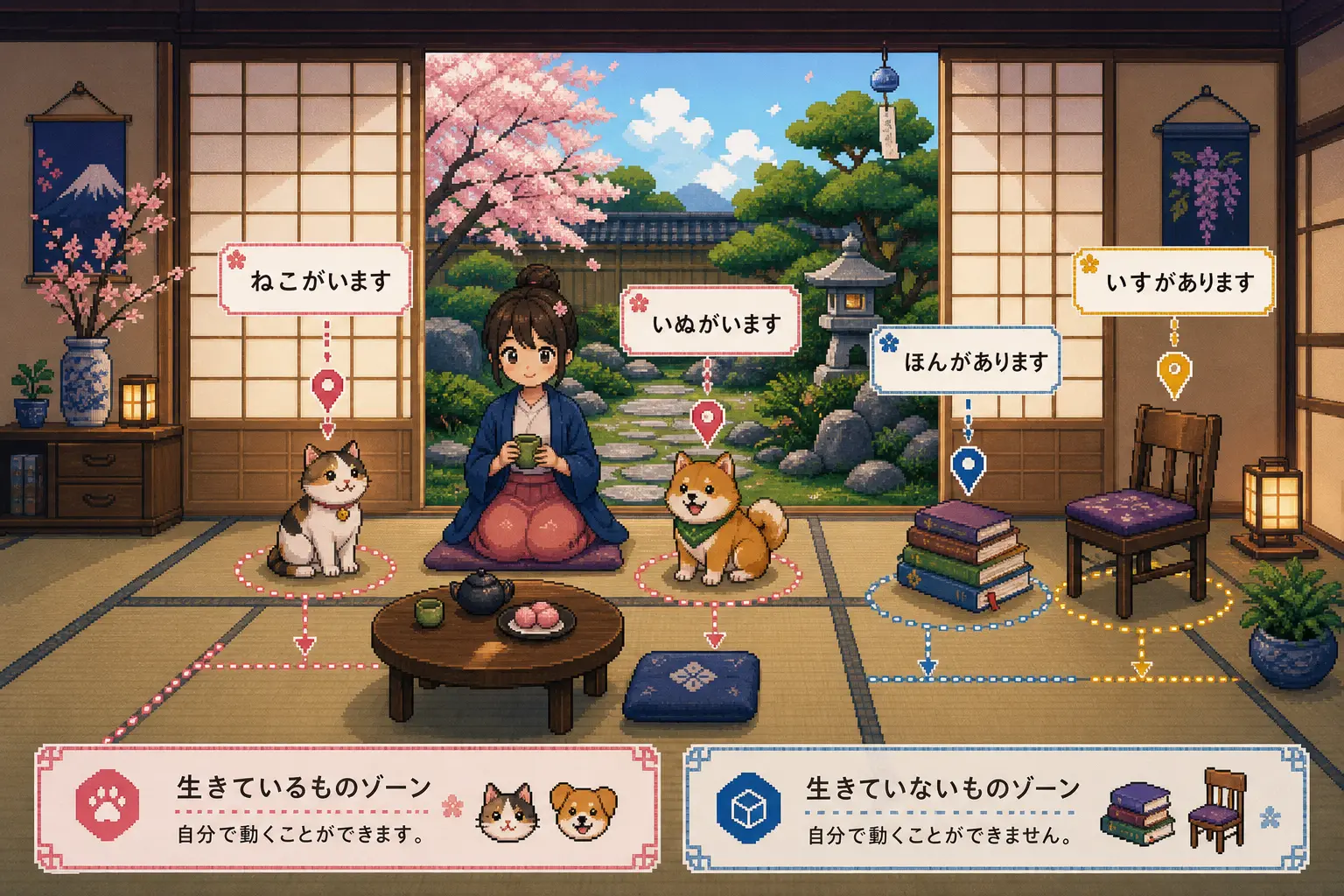
1. Inanimate Existence: ある (Aru)
The verb ある (aru) is used for anything that is inanimate (not alive) or things that are alive but cannot move on their own (like plants and trees). It is a Group 1 verb. Its polite form is あります (arimasu).
means There is a [Noun]. / I have a [Noun].
Formation
Inanimate Noun + が + あります
ほん が あります。
Hon ga arimasu.
There is a book. (Or: I have a book.)
じかん が あります。
Jikan ga arimasu.
There is time. / I have time.
ホテル に プール が あります。
Hoteru ni puuru ga arimasu.
There is a pool at the hotel.
くるま が あります。
Kuruma ga arimasu.
There is a car.
きょう、 テスト が あります。
Kyou, tesuto ga arimasu.
There is a test today.
こうえん に き が あります。
Kouen ni ki ga arimasu.
There is a tree in the park.
2. Animate Existence: いる (Iru)
The verb いる (iru) is used for people, animals, and insects—anything that is alive and can move of its own volition. It is a Group 2 verb. Its polite form is います (imasu).
means There is a [Person/Animal]. / I have a [Person/Animal].
Formation
Animate Noun + が + います
ねこ が います。
Neko ga imasu.
There is a cat. (Or: I have a cat.)
あそこ に たなかさん が います。
Asoko ni Tanaka-san ga imasu.
Mr. Tanaka is over there.
へや に いぬ が います。
Heya ni inu ga imasu.
There is a dog in the room.
きょうだい が います。
Kyoudai ga imasu.
I have siblings.
あそこに だれ が います か。
Asoko ni dare ga imasu ka.
Who is over there?
ともだち が たくさん います。
Tomodachi ga takusan imasu.
I have many friends.
ある or いる? Pick by 'can it move on its own?'
The choice is not “alive vs. not alive” — it’s self-movement:
- いる → people, animals, insects (things that move on their own). 犬がいます.
- ある → objects, and plants/trees (alive, but they don’t move). 木があります, not
木がいます. - Both take が for the thing that exists, and the negatives are ありません / いません (never
あらない).
A common trap: a parked car uses ある (車があります) — but talk about the driver inside and you switch to いる.
3. Describing Location with “に”
To say where something exists, you place the location word before the particle に (ni).
means [Noun] is in/at [Location].
Formation
Location + に + Noun + が + Verb
としょかん に ほん が あります。
Toshokan ni hon ga arimasu.
There are books in the library.
こうえん に ねこ が います。
Kouen ni neko ga imasu.
There is a cat in the park.
つくえ の うえ に ペン が あります。
Tsukue no ue ni pen ga arimasu.
There is a pen on top of the desk.
はこ の なか に なに が あります か。
Hako no naka ni nani ga arimasu ka.
What is inside the box?
ぎんこう の まえ に くるま が あります。
Ginkou no mae ni kuruma ga arimasu.
There is a car in front of the bank.
ベッド の した に いぬ が います。
Beddo no shita ni inu ga imasu.
The dog is under the bed.
4. Cultural Note: The Aesthetic of ‘Wabi-sabi’ (わびさび)
Wabi-sabi is a world view centered on the acceptance of transience and imperfection. It is often described as beauty that is “imperfect, impermanent, and incomplete.”
- In Space: A room designed with Wabi-sabi principles might feel empty or “lonely” to a Western eye, but this emptiness (related to ‘Ma’) is intended to foster focus and peace.
- In Existence: The verbs aru and iru help define the existence of things within these spaces. Whether it’s a cracked tea bowl (aru) or the moss growing on a stone (aru), Wabi-sabi finds dignity in the natural cycle of life and decay.
- Characteristics: Asymmetry, roughness, simplicity, and appreciation of the ingenuous integrity of natural objects and processes.
Conversation Practice
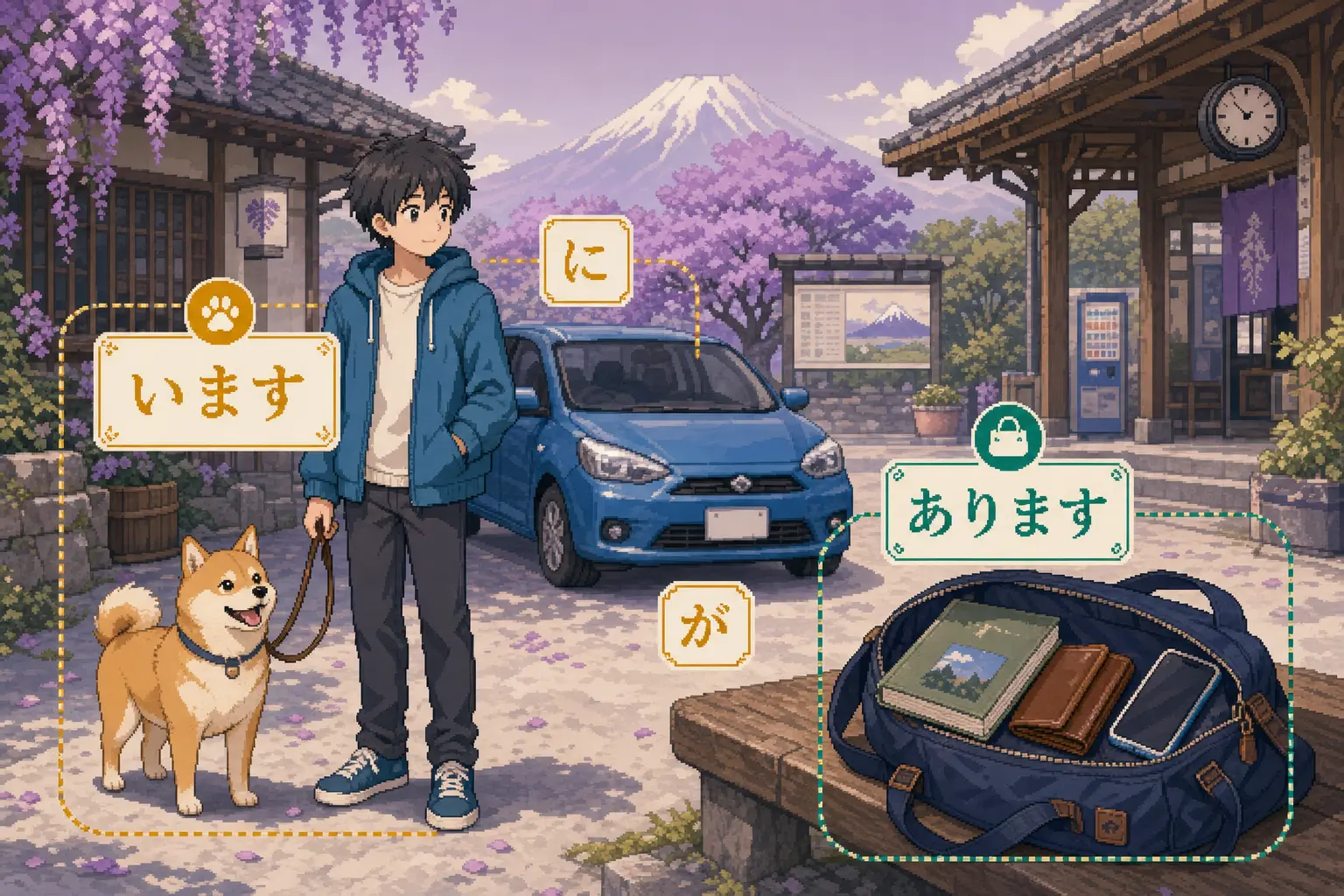
すみません、 たなかさん は どこ に います か。
Sumimasen, Tanaka-san wa doko ni imasu ka?
Excuse me, where is Mr. Tanaka?
たなかさん は あそこ に います よ。 あおい くるま の まえ です。
Tanaka-san wa asoko ni imasu yo. Aoi kuruma no mae desu.
Mr. Tanaka is over there. In front of the blue car.
あ、 わかりました。 ありがとうございます。
A, wakarimashita. Arigatou gozaimasu.
Ah, I see. Thank you very much.
いいえ。 あ、 たなかさん の となり に いぬ も います よ。
Iie. A, Tanaka-san no tonari ni inu mo imasu yo.
No problem. Oh, there's also a dog next to Mr. Tanaka.
その かばん の なか に なに が あります か。
Sono kaban no naka ni nani ga arimasu ka?
What is inside that bag (near you)?
ほん と さいふ が あります。 それから、 スマホ も あります。
Hon to saifu ga arimasu. Sorekara, sumaho mo arimasu.
There's a book and a wallet. And also a smartphone.
おべんとう は ありません か。
Obentou wa arimasen ka?
Is there no lunch box?
はい、 ありません。 レストラン で たべます。
Hai, arimasen. Resutoran de tabemasu.
Yes, there isn't. I'll eat at a restaurant.
Chapter Summary
- 1ある (arimasu) is used for inanimate objects, plants, and abstract concepts.
- 2いる (imasu) is used for living, moving things like people and animals.
- 3Use the particle が (ga) to mark the subject that exists.
- 4Use the particle に (ni) to mark the location of existence.
- 5Position words like うえ, した, and なか specify where an object is located.
- 6Wabi-sabi is the Japanese art of finding beauty in imperfection and existence.
Knowledge Check
Test your understanding of existence and location!
Which verb do you use for 'There is a person'?
Practice Quiz
Which verb do you use for 'There is a person'?
- あります
- います
- します
- きます
Which verb do you use for 'There is a book'?
- あります
- います
- ありますした
- いません
Translate: 'I have a cat.'
- ねこ を あります。
- ねこ が います。
- ねこ に あります。
- ねこ は います。
Which particle marks the location where something exists?
- を
- は
- に
- へ
What does 'つくえ の うえ' mean?
- Under the desk
- Inside the desk
- On top of the desk
- Next to the desk
Translate: 'じかん が ありません。'
- I have time.
- I don't have time.
- There is no person.
- Where is the time?
Which verb group does 'ある' belong to?
- Group 1
- Group 2
- Group 3
- Exception
Which verb group does 'いる' belong to?
- Group 1
- Group 2
- Group 3
- Exception
What is 'Wabi-sabi'?
- A type of spicy condiment
- The art of finding beauty in imperfection
- A Japanese holiday
- A martial art
Translate: 'Hako no naka ni nani ga arimasu ka.'
- Where is the box?
- What is inside the box?
- Who is in the box?
- Is there a box?
How do you say 'There is a tree'?
- き が あります。
- き が います。
- き を あります。
- き に います。
Which word means 'Behind'?
- まえ
- うしろ
- となり
- なか
Translate: 'Tanaka-san wa ginkou ni imasu.'
- Mr. Tanaka is at the bank.
- Mr. Tanaka is going to the bank.
- Mr. Tanaka is the bank.
- Is Mr. Tanaka at the bank?
Fill in the blank: 'Asoko _____ inu が います。' (There is a dog over there).
- を
- に
- は
- が
True or False: Robots that move on their own usually take 'imasu'.
- True
- False
What is the polite negative of 'います' (imasu)?
- いません
- いりません
- ないです
- ありません
Translate: 'ベッド の した に いぬ が います。'
- There is a dog under the bed.
- There is a dog on the bed.
- There is a cat behind the bed.
- There is a dog next to the bed.
Which position word means 'next to'?
- となり
- うえ
- した
- なか
Why does a parked car take あります, but the driver inside takes います?
- A parked car cannot move on its own, but the human driver can.
- Cars are always Group 1 verbs.
- Humans are always nouns with が.
- Cars are from foreign countries (katakana).
Translate: 'かばん の なか に なに が あります か。'
- What is inside the bag?
- Where is the bag?
- Who has the bag?
- Is there a bag inside?
Applied review
Use what you learned
Focus: Existence ある and いる. Try the task before revealing the model.
Produce the Japanese sentence, then compare it with the model answer.
1.Say “There is a cat under the chair.”
Existence ある and いる in context
N5 mini-reading
- Which item is inanimate?