Particle を & Verbs Part 2
Learning objectives
- Use the particle を (o) to identify the direct object of an action.
- Expand your vocabulary with essential transitive verbs.
- Form complete Subject-Object-Verb (SOV) sentences.
- Understand the cultural importance of dining etiquette in Japan.
In previous chapters, we learned how to say “I go” or “I am.” But what if you want to say “I eat sushi” or “I read a book”? To do this, you need a way to link the action (the verb) to the thing being acted upon (the object). In Japanese, this is the job of the Particle を (o). By mastering this particle, you unlock the ability to describe almost any daily activity.
1. The Direct Object Particle: を (o)
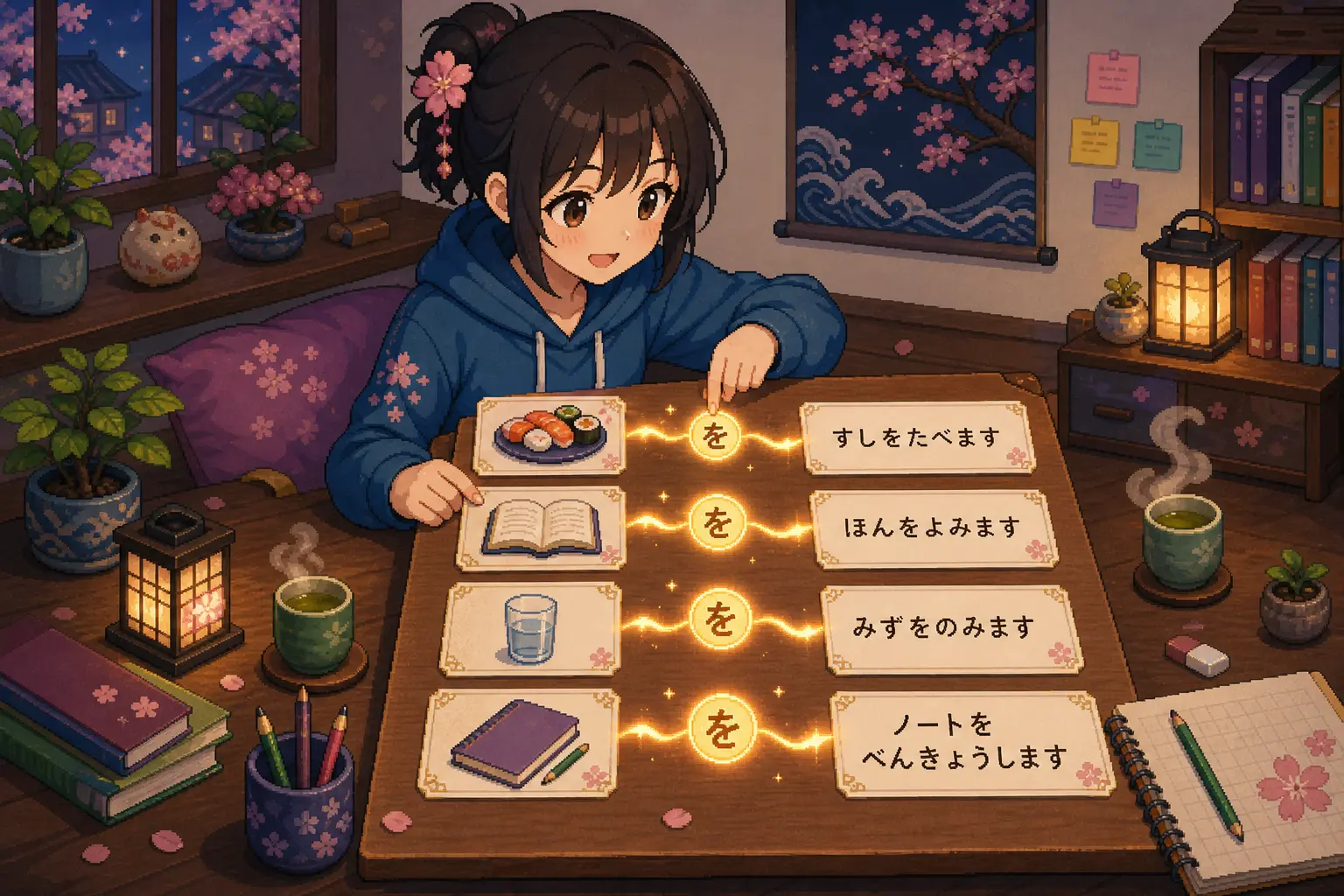
The particle を marks the Direct Object—the person or thing that receives the action of the verb.
[!CAUTION] Although written as を (wo), it is pronounced simply as “o” in modern Japanese. It is used exclusively as a particle.
means Marks the object that is being acted upon.
Formation
Object + を + Transitive Verb
みず を のみます。
Mizu o nomimasu.
I drink water.
ほん を よみます。
Hon o yomimasu.
I read a book.
テレビ を みます。
Terebi o mimasu.
I watch TV.
あさごはん を たべます。
Asagohan o tabemasu.
I eat breakfast.
てがみ を かきました。
Tegami o kakimashita.
I wrote a letter.
にほんご を べんきょうします。
Nihongo o benkyoushimasu.
I study Japanese.
を marks the object — not the destination
Use を only for the thing the verb acts on. For where you go, use に / へ, not を:
- ✅ ごはん を たべます — eat rice (object).
- ✅ がっこう へ いきます — go to school (destination).
- ❌ がっこう を いきます — “iku” (to go) doesn’t act on the school.
(One special case you’ll meet later: を can mark the place you move through — 公園を歩く, “walk through the park” — but never the place you go to.)
2. Transitive Verbs (Action Verbs)
A “Transitive Verb” is an action that requires an object. You can’t just “eat”—you have to eat something. Here are some of the most common transitive verbs you’ll need for N5.
たべます
Verbtabemasu
to eat
のみます
Verbnomimasu
to drink
よみます
Verbyomimasu
to read
かきます
Verbkakimasu
to write / draw
みます
Verbmimasu
to see / watch / look
ききます
Verbkikimasu
to listen / hear
かいます
Verbkaimasu
to buy
とります
Verbtorimasu
to take (a photo)
おんがく を ききます。
Ongaku o kikimasu.
I listen to music.
しゃしん を とりました。
Shashin o torimashita.
I took a photo.
パン を かいます。
Pan o kaimasu.
I will buy bread.
3. Sentence Structure: Topic-Object-Verb
Remember that Japanese is an SOV (Subject-Object-Verb) language. The verb always comes at the end.
means The complete standard sentence structure for actions.
Formation
Topic + は + Object + を + Verb
わたし は りんご を たべます。
Watashi wa ringo o tabemasu.
I eat an apple.
たなかさん は おさけ を のみません。
Tanaka-san wa osake o nomimasen.
Mr. Tanaka does not drink alcohol.
だれ が コーヒー を のみました か。
Dare ga koohii o nomimashita ka.
Who drank the coffee?
ともだち は ざっし を よみました。
Tomodachi wa zasshi o yomimashita.
My friend read a magazine.
せんせい は ひらがな を かきます。
Sensei wa hiragana o kakimasu.
The teacher writes hiragana.
あね は えいが を みませんでした。
Ane wa eiga o mimasen deshita.
My older sister did not watch the movie.
4. Cultural Note: Dining Etiquette (食事の作法)
In Japan, eating is more than just nutrition; it is an act of gratitude.
- Itadakimasu (いただきます): Before eating, place your hands together and say this. It literally means “I humbly receive,” acknowledging the sacrifice of the plants and animals and the hard work of the chef and farmers.
- Gochisousama deshita (ごちそうさまでした): After finishing your meal, say this to express that “It was a feast.” It shows appreciation for the effort put into the meal.
- Chopstick Taboos: Never pass food directly from your chopsticks to another person’s, and never stick your chopsticks vertically into a bowl of rice (this is associated with funeral rituals).
- Lifting Bowls: It is perfectly polite (and often expected) to lift small bowls of rice or miso soup toward your mouth while eating.
Conversation Practice
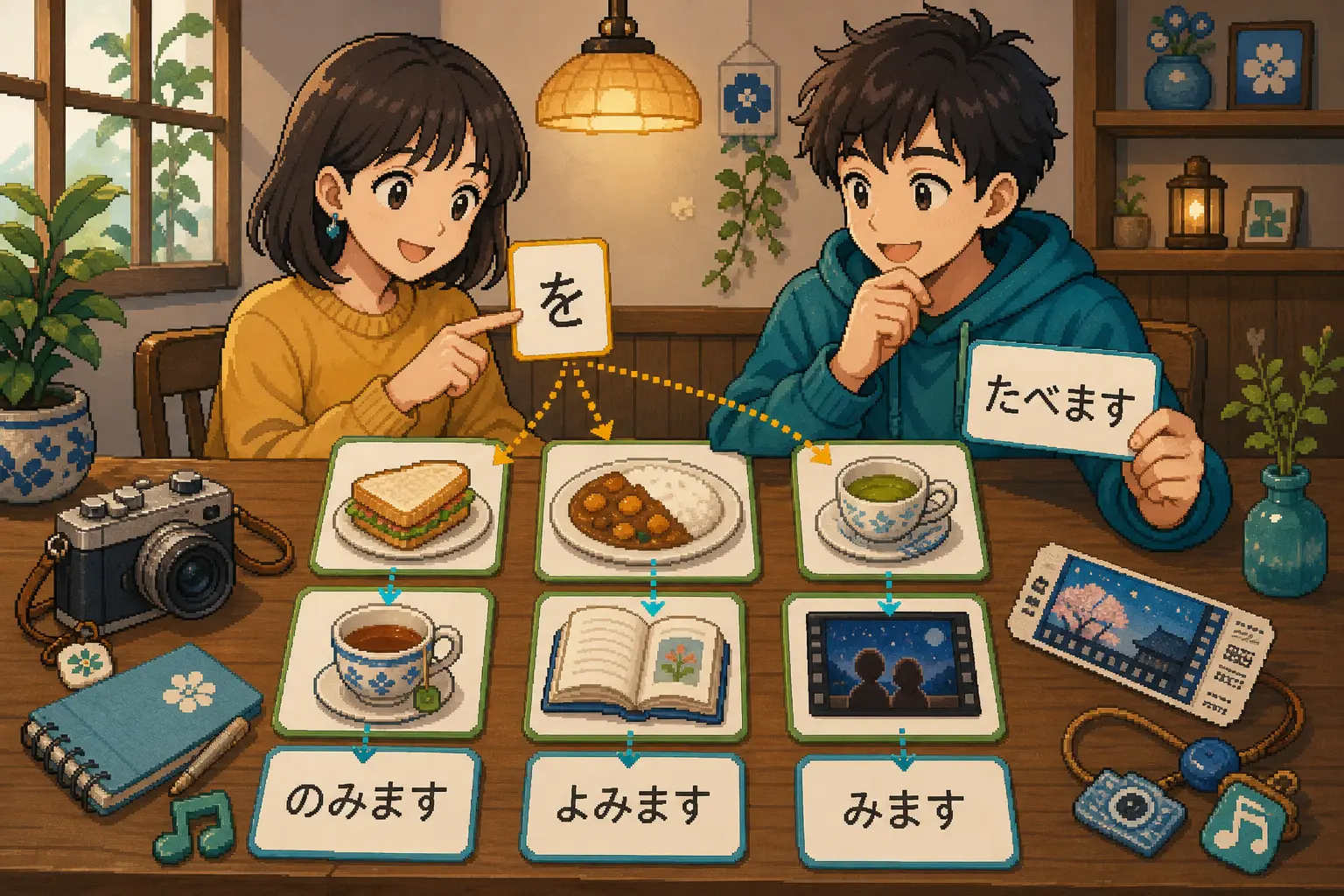
スミスさん、なに を たべます か。
Sumisu-san, nani o tabemasu ka?
Mr. Smith, what will you eat?
わたし は サンドイッチ を たべます。 たなかさん は?
Watashi wa sandoitchi o tabemasu. Tanaka-san wa?
I will eat a sandwich. How about you, Tanaka?
わたし は カレー を たべます。 それから、おちゃ を のみます。
Watashi wa karee o tabemasu. Sorekara, ocha o nomimasu.
I will eat curry. And then, I'll drink green tea.
いい です ね。 あ、しゃしん を とりましょう!
Ii desu ne. A, shashin o torimashou!
That's good. Oh, let's take a photo!
きのう、 なに を しました か。
Kinou, nani o shimashita ka?
What did you do yesterday?
えいが を みました。 それから、 ほん を よみました。
Eiga o mimashita. Sorekara, hon o yomimashita.
I watched a movie. And then, I read a book.
おんがく を ききました か。
Ongaku o kikimashita ka?
Did you listen to music?
いいえ、 ききませんでした。 べんきょう を しました。
Iie, kikimasendeshita. Benkyou o shimashita.
No, I didn't. I studied.
Chapter Summary
- 1The particle を (o) marks the direct object of a verb.
- 2Japanese follows the SOV (Subject-Object-Verb) structure.
- 3Common transitive verbs include たべます, のみます, よみます, and みます.
- 4Pronounce を as 'o', even though it's typed as 'wo'.
- 5Always say 'Itadakimasu' before a meal and 'Gochisousama deshita' after.
Knowledge Check
Test your understanding of the particle を and daily verbs!
Which particle marks the direct object of a verb?
Practice Quiz
Which particle marks the direct object of a verb?
- は (wa)
- が (ga)
- を (o)
- に (ni)
How is the particle を usually pronounced?
- wo
- o
- u
- ho
Translate: 'I drink water.'
- みず は のみます。
- みず を のみます。
- みず が のみます。
- みず に のみます。
Which word means 'to read'?
- たべます
- のみます
- よみます
- みます
Where does the verb usually go in a Japanese sentence?
- At the beginning
- In the middle
- At the end
- It doesn't matter
What do you say BEFORE eating a meal?
- Gochisousama
- Arigatou
- Itadakimasu
- Oyasumi
Translate: 'I watch TV.'
- テレビ を みます。
- テレビ を よみます。
- テレビ を ききます。
- テレビ を かきます。
Which of these is a 'Chopstick Taboo'?
- Lifting your bowl
- Passing food from chopstick to chopstick
- Eating rice
- Using chopsticks with sushi
Translate: 'Hon o yomimasu.'
- I eat a book.
- I read a book.
- I see a book.
- I write a book.
What is the polite negative of 'たべます'?
- たべません
- たべました
- たべませんで
- たべでした
How do you say 'I took a photo'?
- しゃしん を かきました。
- しゃしん を とりました。
- しゃしん を みました。
- しゃしん を ききました。
What does 'Sorekara' mean in a list of actions?
- Because
- Therefore
- And then / After that
- But
Translate: 'Nani o shimashita ka.'
- What are you doing?
- What did you do?
- Where are you going?
- Who are you?
If you want to say 'I buy bread', which is correct?
- パン を かいます。
- パン を ききます。
- パン を みます。
- パン を きます。
What is said AFTER a meal?
- Itadakimasu
- Sayounara
- Gochisousama deshita
- Sumimasen
Which sentence correctly says 'I listen to music'?
- おんがく を ききます。
- おんがく に ききます。
- おんがく で ききます。
- おんがく が ききます。
Which particle error is made in the sentence 'がっこう を いきます'?
- Going to a place is a destination, so it requires へ or に, not を.
- がっこう is an adjective, so it cannot take を.
- いきます cannot be used with places.
- The particle を should follow the verb.
Translate: 'せんせい は ひらがな を かきます。'
- The teacher writes hiragana.
- The teacher reads hiragana.
- The teacher studies hiragana.
- The teacher teaches hiragana.
Why should you never stick chopsticks vertically into a bowl of rice in Japan?
- It resembles incense offered at Buddhist funerals.
- It breaks the chopsticks easily.
- It makes the rice turn cold faster.
- It is considered an insult to the chef's knife.
Translate: 'きのう えいが を みませんでした。'
- I did not watch a movie yesterday.
- I did not watch TV yesterday.
- I watched a movie yesterday.
- I will not watch a movie tomorrow.
Applied review
Use what you learned
Focus: Direct objects with を. Try the task before revealing the model.
Produce the Japanese sentence, then compare it with the model answer.
1.Say “I eat bread and drink tea.”
Direct objects with を in context
N5 mini-reading
- What happens after lunch?