Verb Conjugation: ます-form
Learning objectives
- Understand the importance of the polite (ます) form in daily life.
- Conjugate Group 2 (ru-verbs) by dropping る.
- Conjugate Group 1 (u-verbs) by shifting the vowel to the 'i' row.
- Master the polite forms of irregular verbs (する and くる).
Every Japanese verb belongs to one of three groups, and the group decides exactly how a verb conjugates — for politeness, tense, and every form you’ll ever learn. Using the plain “dictionary form” (like taberu) with strangers, teachers, or superiors can sound too casual or even rude. To speak politely, we use the ます (masu) form: the standard polite way to talk about the present and future.
This chapter teaches you to recognize each group and conjugate its ます-form. Chapter 12 then goes deeper into classifying verbs and using the plain dictionary form.
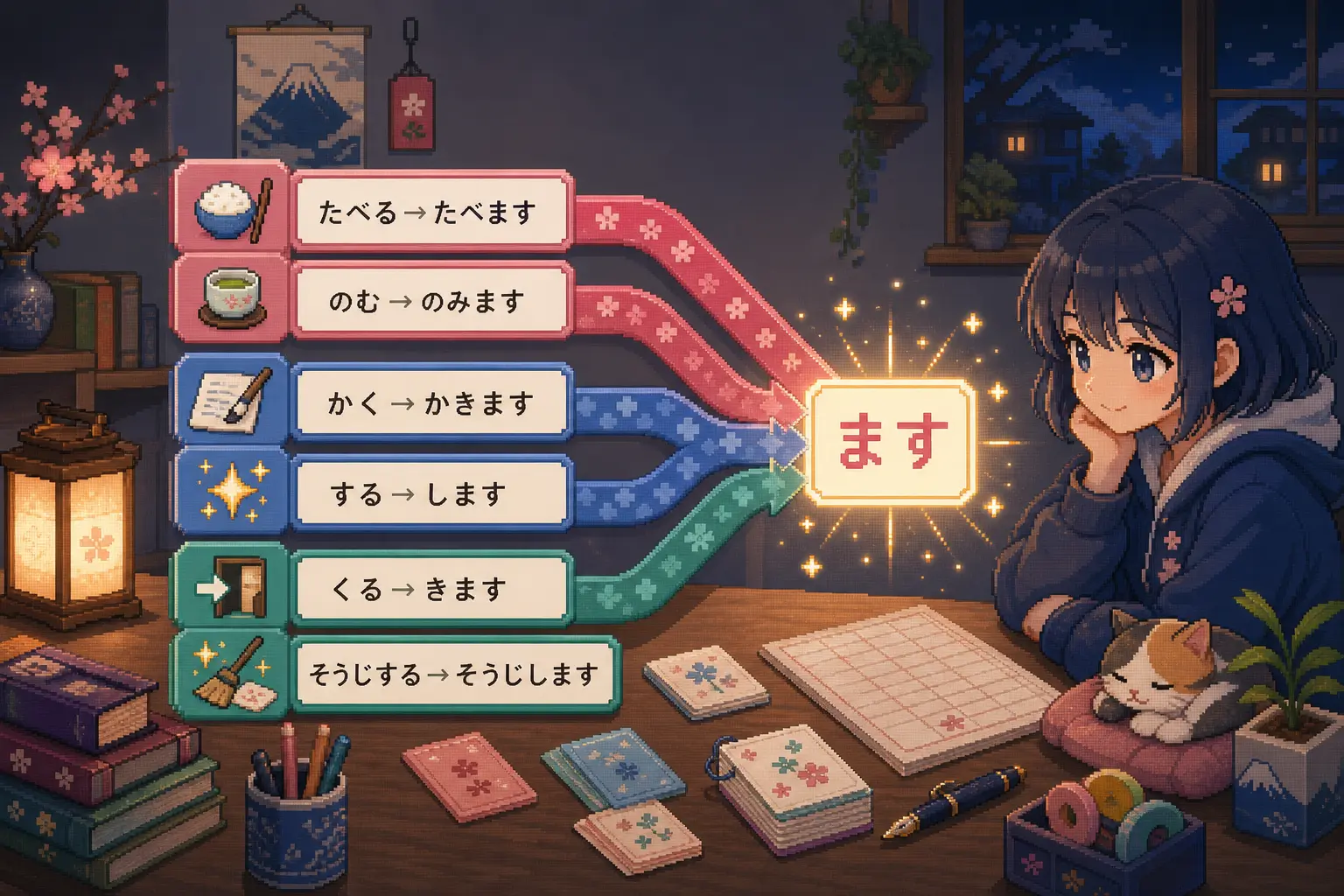
[!NOTE] Spotting the groups (quick version):
- Group 2 (ru-verbs): end in る with an i or e sound before it — たべる (tabe-ru), みる (mi-ru).
- Group 1 (u-verbs): every other verb — のむ, かく, はなす, and some る-verbs like かえる (to return).
- Group 3 (irregular): only する and くる.
1. Group 2 (ru-verbs): The Easy Drop
Group 2 verbs (like taberu, miru) are the simplest to conjugate. You just remove the final る and replace it with ます.
means Polite Present Affirmative for Group 2.
Formation
Drop る + Add ます (Affirmative) / ません (Negative)
リンゴ を たべます。
Ringo o tabemasu.
I eat an apple.
テレビ を みます。
Terebi o mimasu.
I watch TV.
しちじ に おきます。
Shichi-ji ni okimasu.
I wake up at 7:00.
じゅうじ に ねます。
Juu-ji ni nemasu.
I go to sleep at 10:00.
2. Group 1 (u-verbs): The Vowel Shift
Group 1 verbs (like nomu, kaku) require a small change. You take the final character (which ends in an “u” sound) and change it to the corresponding character in the “i” row of the Hiragana chart. Then add ます.
Example: のむ (no-mu) ➔ のみ (no-mi) + ます ➔ のみます (nomimasu).
means Polite Present Affirmative for Group 1.
Formation
Change final 'u' sound to 'i' sound + Add ます
みず を のみます。
Mizu o nomimasu.
I drink water.
てがみ を かきます。
Tegami o kakimasu.
I write a letter.
にほんご を はなします。
Nihongo o hanashimasu.
I speak Japanese.
ほん を よみます。
Hon o yomimasu.
I read a book.
うちに かえります。
Uchi ni kaerimasu.
I return home.
3. Group 3 (Irregular): Memorize!
There are only two irregular verbs, so just memorize their polite forms:
- する (suru) ➔ します (shimasu) [to do]
- くる (kuru) ➔ きます (kimasu) [to come]
means Polite forms of 'do' and 'come'.
Formation
Memorize: suru -> shimasu, kuru -> kimasu
べんきょう を します。
Benkyou o shimasu.
I study.
がっこう に きます。
Gakkou ni kimasu.
I come to school.
テニス を します。
Tenisu o shimasu.
I play tennis.
4. The Negative: 〜ません (masen)
To say you don’t do something, the rules for the root word stay exactly the same, but you use ません instead of ます.
たべません
Negativetabemasen
Do not eat
のみません
Negativenomimasen
Do not drink
しません
Negativeshimasen
Do not do
きません
Negativekimasen
Do not come
ます-form at a glance (one verb per group)
The negative simply swaps ます → ません for every group.
5. Cultural Note: Desu/Masu vs. Plain Form
In Japan, the level of politeness you use depends on your relationship with the listener.
- Polite (Desu/Masu): Used with people you don’t know well, teachers, bosses, and older people. It is the “safety” level—using it ensures you are never seen as rude.
- Plain (Dictionary): Used with close friends, family, and younger people.
- The Transition: Even if you become friends with someone, many Japanese people continue to use polite forms until an explicit or implicit agreement to use casual speech (tame-guchi) is reached. When in doubt, stick to ます!
Conversation Practice
たなかさん、 毎日 何時 に おきます か。
Tanaka-san, mainichi nan-ji ni okimasu ka.
Mr. Tanaka, what time do you wake up every day?
わたし は 毎日 しちじ に おきます。
Watashi wa mainichi shichi-ji ni okimasu.
I wake up at 7:00 every day.
朝ごはん を たべます か。
Asagohan o tabemasu ka.
Do you eat breakfast?
はい、 たべます。 パン を たべます。 アリスさん は?
Hai, tabemasu. Pan o tabemasu. Arisu-san wa?
Yes, I do. I eat bread. How about you, Alice?
わたし は たべません。 コーヒー を のみます。
Watashi wa tabemasen. Koohii o nomimasu.
I don't eat. I drink coffee.
明日、 どこ へ いきます か。
Ashita, doko e ikimasu ka.
Where will you go tomorrow?
としょかん へ いきます。 ほん を よみます。
Toshokan e ikimasu. Hon o yomimasu.
I'll go to the library. I'll read books.
テニス を します か。
Tenisu o shimasu ka.
Will you play tennis?
いいえ、 しません。
Iie, shimasen.
No, I won't.
Chapter Summary
- 1ます (masu) is the polite present/future form of a verb.
- 2Group 2: Drop る and add ます (e.g., taberu -> tabemasu).
- 3Group 1: Shift the final 'u' sound to 'i' and add ます (e.g., nomu -> nomimasu).
- 4Irregular: する -> します, くる -> きます.
- 5The negative form for all groups is 〜ません (masen).
- 6Use polite speech (Desu/Masu) with strangers and superiors.
Knowledge Check
Test your conjugation skills!
Which of the following is the polite form of 'たべる' (taberu)?
Practice Quiz
Which of the following is the polite form of 'たべる' (taberu)?
- たべます
- たべります
- たべします
- たべります
Conjugate 'のむ' (nomu) into the polite form.
- のむます
- のみます
- のみますます
- のめます
What is the polite negative of 'する' (suru)?
- しません
- すりません
- しませて
- しります
Which group does 'みる' (miru) belong to and what is its polite form?
- Group 1, みります
- Group 2, みます
- Group 3, みします
- Group 2, みります
Translate: 'I do not drink coffee.'
- コーヒー を のみます。
- コーヒー を のみません。
- コーヒー を たべません。
- コーヒー を しません。
How do you conjugate 'かえる' (kaeru - to return home)?
- かえます
- かえります
- かえします
- かえりますます
What is the polite form of 'くる' (kuru)?
- くます
- きます
- こます
- くりまります
Translate: 'I study every day.'
- 毎日 べんきょう を します。
- 毎日 べんきょう を しません。
- 毎日 べんきょう です。
- 毎日 べんきょう を きます。
What vowel row do Group 1 verbs shift to before adding 'masu'?
- a row
- i row
- u row
- e row
Which is the correct negative for 'おきます' (wake up)?
- おきない
- おきません
- おきじゃありません
- おきませんでした
Translate: 'What time do you sleep?'
- 何時 に ねます か。
- 何時 に おきます か。
- 何時 に きます か。
- 何時 です か。
True or False: Using 'masu' form with your boss is considered polite and appropriate.
- True
- False
Fill in the blank: 'Hon o _____' (I read a book).
- よみます
- よむます
- よみします
- よめます
What does 'tabemasen' mean?
- I eat
- I am eating
- I do not eat
- I did not eat
Which verb means 'to return home'?
- いきます
- きます
- かえります
- ねます
What is the polite form of 'はなす' (hanasu - to speak)?
- はなします
- はなすます
- はなせます
- はなちます
What is the polite form of 'まつ' (matsu - to wait)?
- まちます
- まつます
- まてます
- まします
What is the polite negative form of 'ねる' (neru - to sleep)?
- ねません
- ねりません
- ねないです
- ねしません
Translate: 'あした ともだち が きます。'
- A friend will come tomorrow.
- A friend came tomorrow.
- I will go with a friend tomorrow.
- A friend will do it tomorrow.
Which of the following is a compound verb using the irregular verb する?
- べんきょうします
- たべます
- いきます
- のみます
Applied review
Use what you learned
Focus: Polite verb forms. Try the task before revealing the model.
Produce the Japanese sentence, then compare it with the model answer.
1.Change 読む into polite affirmative and negative.
Polite verb forms in context
N5 mini-reading
- When does the speaker not read the newspaper?