Basic Particles Recap
Learning objectives
- Consolidate the usage of core particles: は, が, を, に, で, へ, と, も.
- Master the directional and range particles から and まで.
- Review how particles interact with expressing desires (ほしい and 〜たい).
- Explore the Japanese culture of seasonal gift-giving (Ochuugen and Oseibo).
Particles are the unsung heroes of Japanese grammar. Without them, a sentence is just a pile of nouns and verbs with no relationship. You’ve encountered many particles in the first 15 chapters, but as you move toward N4, it is vital to have a rock-solid foundation. In this chapter, we will recap the core “glue” of the language and see how these particles work together in complex scenarios.
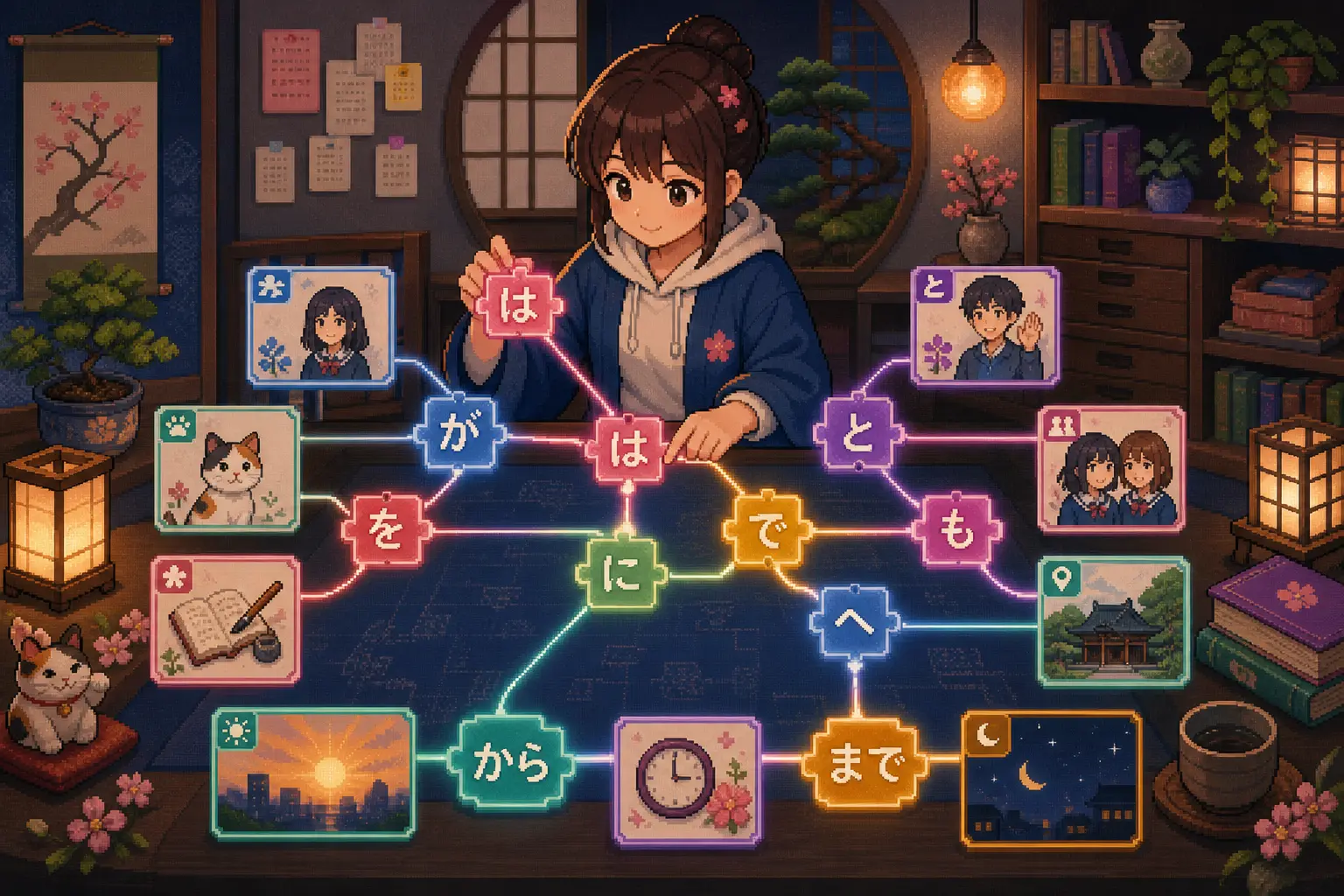
1. The Core Three: は, が, and を
The most fundamental particles define the Topic (は), the Subject (が), and the Object (を).
- は (wa): Sets the stage. “As for X…”
- が (ga): Identifies the specific do-er or the subject of an adjective/existence.
- を (o): Identifies the target of a transitive action.
means Defining roles in a sentence.
Formation
Noun + Particle
わたし は ラーメン を たべます。
Watashi wa raamen o tabemasu.
As for me, I eat ramen.
だれ が きました か。
Dare ga kimashita ka?
Who (specifically) came?
この ほん が ほしい です。
Kono hon ga hoshii desu.
I want this book. (Desire uses が)
たなかさん は コーヒー を のみます。
Tanaka-san wa koohii o nomimasu.
Mr. Tanaka drinks coffee.
あそこ に いぬ が います。
Asoko ni inu ga imasu.
There is a dog over there.
なに が おいしい です か。
Nani ga oishii desu ka?
What (specifically) is delicious?
は vs が vs を — who does what to what
わたし は がくせい です。
watashi wa gakusei desu — 'As for me, (I) am a student.'
だれ が きました か。
dare ga kimashita ka — identifies the specific doer.
ごはん を たべます。
gohan o tabemasu — marks the thing acted upon.
2. Location & Direction: に, で, and へ
These particles tell us where things are or where they are going.
- に (ni): A specific point in time, a location of existence, or a target.
- で (de): The location where an action takes place, or the tool/means used.
- へ (e): The direction of movement (towards).
means Mapping space and time.
Formation
Location/Time + Particle
がっこう に いきます。
Gakkou ni ikimasu.
I go to school.
としょかん で べんきょうします。
Toshokan de benkyoushimasu.
I study at the library.
バス で かえります。
Basu de kaerimasu.
I return home by bus.
しちじ に おきます。
Shichi-ji ni okimasu.
I wake up at 7:00.
にほん へ いきたい です。
Nihon e ikitai desu.
I want to go to Japan.
レストラン で さかな を たべました。
Resutoran de sakana o tabemashita.
I ate fish at a restaurant.
3. Range & Connection: から, まで, と, and も
These particles handle boundaries and additions.
- から (kara): Starting point (from).
- まで (made): Ending point (until/to).
- と (to): “And” (between nouns) or “With” (a person).
- も (mo): “Also/Too” (replaces は, が, or を).
means Defining limits and relationships.
Formation
Noun + Particle
とうきょう から きょうと まで いきます。
Toukyou kara Kyouto made ikimasu.
I go from Tokyo to Kyoto.
ともだち と えいが を みました。
Tomodachi to eiga o mimashita.
I watched a movie with a friend.
わたし も すし が すき です。
Watashi mo sushi ga suki desu.
I also like sushi.
くじ から ごじ まで はたらきます。
Ku-ji kara go-ji made hatarakimasu.
I work from 9:00 until 5:00.
あした も テスト が あります。
Ashita mo tesuto ga arimasu.
There is a test tomorrow too.
4. Cultural Note: Seasonal Gifts (Ochuugen & Oseibo)
In Japan, the relationship between people is often maintained through Giri (social obligation) and the practice of gift-giving. Two major seasons define this:
- Ochuugen (お中元): Mid-summer gifts (July) sent to express gratitude to superiors, teachers, or clients. People often send “cool” items like beer, jelly, or fruit to combat the summer heat.
- Oseibo (お歳暮): Year-end gifts (December) sent to thank people for their support throughout the year.
Particle Connection: When discussing these gifts, the particles に (to) and から (from) are essential.
- Sensei ni oseibo o agemasu. (I give a year-end gift to the teacher.)
- Tanaka-san kara ochuugen o moraimashita. (I received a mid-summer gift from Mr. Tanaka.)
The choice of gift is carefully considered to reflect the status of the recipient, demonstrating the high-context nature of Japanese culture.
Conversation Practice
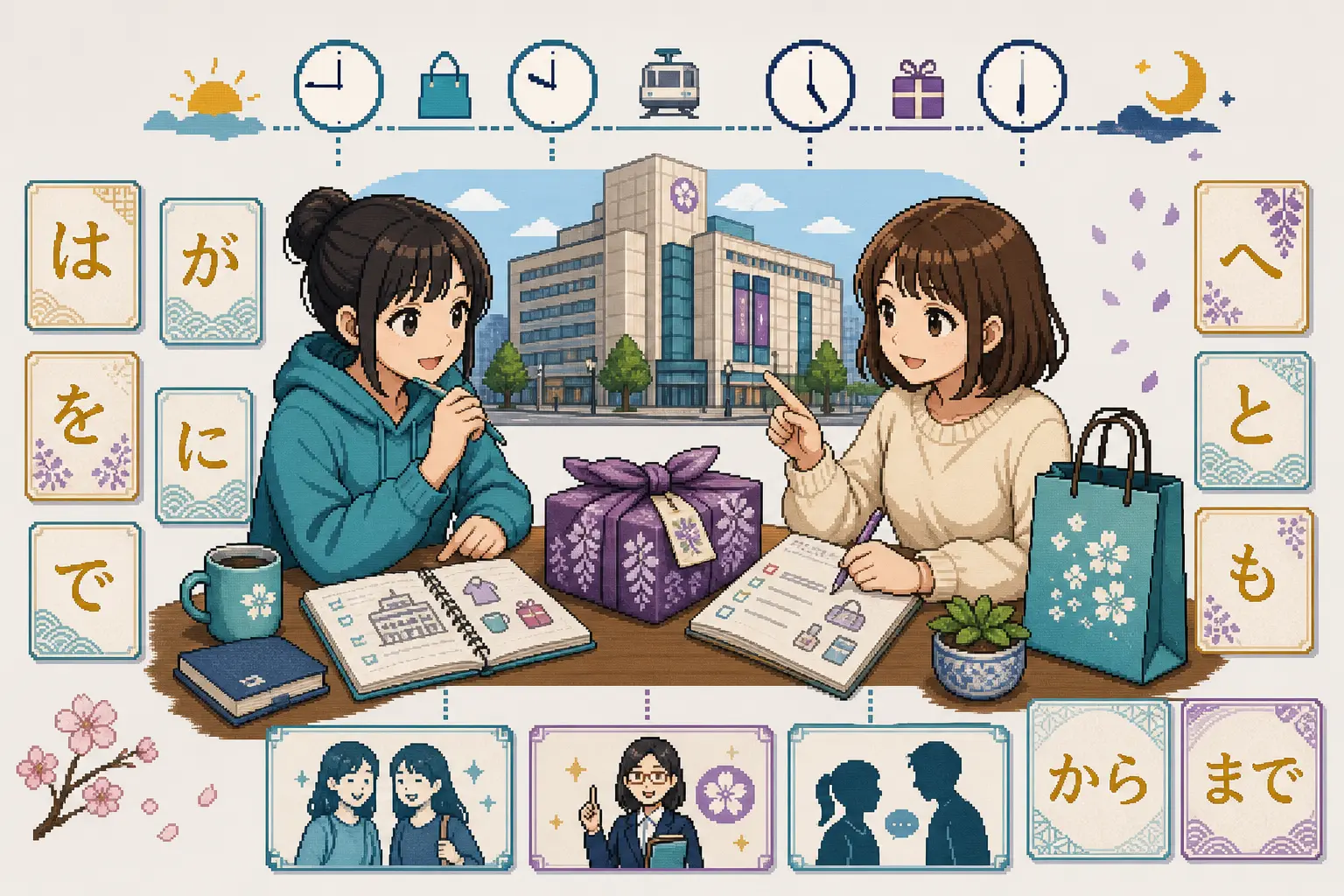
スミスさん、あした は なに を します か。
Sumisu-san, ashita wa nani o shimasu ka?
Mr. Smith, what will you do tomorrow?
あした は じゅうじ に ともだち と デパート へ いきます。
Ashita wa juu-ji ni tomodachi to depaato e ikimasu.
Tomorrow at 10:00, I'm going to a department store with a friend.
デパート で なに を かいます か。
Depaato de nani o kaimasu ka?
What will you buy at the department store?
おちゅうげん を かいます。 せんせい に あげたい です から。
Ochuugen o kaimasu. Sensei ni agetai desu kara.
I'll buy a mid-summer gift. Because I want to give it to my teacher.
いい です ね。 わたし も デパート へ いきたい です。
Ii desu ne. Watashi mo depaato e ikitai desu.
That's nice. I also want to go to the department store.
しごと は なんじ から です か。
Shigoto wa nan-ji kara desu ka?
From what time is work?
くじ から ごじ まで です。 さとうさん も です か。
Ku-ji kara go-ji made desu. Satou-san mo desu ka?
It's from 9:00 until 5:00. Is it the same for you, Mr. Sato?
はい。 でも、きょう は ろくじ まで はたらきます。
Hai. Demo, kyou wa roku-ji made hatarakimasu.
Yes. But today I will work until 6:00.
そうですか。 たいへん です ね。 がんばって ください!
Sou desu ka. Taihen desu ne. Ganbatte kudasai!
I see. That's tough. Good luck!
Chapter Summary
- 1は (wa) introduces the topic, while が (ga) identifies the specific subject.
- 2を (o) marks the direct object of a transitive verb.
- 3に (ni) is for specific time/location; で (de) is for location of action or means.
- 4へ (e) indicates direction; と (to) means 'and/with'; も (mo) means 'also'.
- 5から (from) and まで (until) define the temporal or spatial range.
- 6Seasonal gift-giving (Ochuugen/Oseibo) is a key cultural practice for maintaining social harmony.
Knowledge Check
Test your mastery of Japanese particles!
Which particle marks the destination of a motion verb like 'iku'?
Practice Quiz
Which particle marks the destination of a motion verb like 'iku'?
- を
- へ
- で
- は
Translate: 'I study at the library.'
- としょかん に べんきょうします。
- としょかん で べんきょうします。
- としょかん を べんきょうします。
- としょかん へ べんきょうします。
Which particle is used to mean 'also' or 'too'?
- と
- も
- に
- は
What is the correct particle for 'from' in 'From 9:00'?
- まで
- から
- に
- と
Translate: 'I want a new car.'
- あたらしい くるま を ほしい です。
- あたらしい くるま が ほしい です。
- あたらしい くるま に ほしい です。
- あたらしい くるま は ほしい です。
You are going with a friend. Which particle means 'with'?
- と
- に
- で
- を
How do you say 'Until 5:00'?
- ごじ から
- ごじ まで
- ごじ に
- ごじ と
Which particle marks a specific time point (e.g., at 3:00)?
- に
- で
- を
- は
Translate: 'I go to school by bus.'
- バス に がっこう へ いきます。
- バス で がっこう へ いきます。
- バス を がっこう へ いきます。
- バス は がっこう へ いきます。
Which particle connects two nouns as 'and'?
- も
- と
- に
- を
In 'Tanaka-san wa sushi o tabemasu', what is 'sushi'?
- The Topic
- The Subject
- The Direct Object
- The Location
When are 'Oseibo' gifts typically given?
- July
- April
- December
- January
Translate: 'とうきょう から きょうと まで'
- From Tokyo to Kyoto
- To Tokyo from Kyoto
- Tokyo and Kyoto
- Tokyo also Kyoto
Which particle would you use to emphasize 'WHO' did something (e.g., 'Who ate it?')
- は
- が
- を
- に
True or False: The particle 'へ' is pronounced 'he' when used as a particle.
- True
- False
Translate: 'にほん へ いきたい です。'
- I want to go to Japan.
- I came from Japan.
- I am going to Japan by plane.
- I like Japan.
Which particle replaces は or を when saying 'I also like sushi'?
- も
- と
- に
- で
Which sentence correctly says 'I received a gift from Mr. Tanaka'?
- たなかさん から プレゼント を もらいました。
- たなかさん まで プレゼント を もらいました。
- たなかさん へ プレゼント を もらいました。
- たなかさん で プレゼント を もらいました。
Translate: 'くじ から ごじ まで はたらきます。'
- I work from 9:00 until 5:00.
- I work at 9:00 and 5:00.
- I go to work between 9:00 and 5:00.
- I sleep from 9:00 until 5:00.
In Japanese, which particle introduces contrast (e.g., 'I drink tea, but NOT coffee')?
- は
- を
- が
- で
Applied review
Use what you learned
Focus: Particle selection. Try the task before revealing the model.
Produce the Japanese sentence, then compare it with the model answer.
1.Say “I want to buy a new dictionary at the bookshop.”
Particle selection in context
N5 mini-reading
- Where will the speaker buy the book?