Time & Particle に
Learning objectives
- Tell the time in hours (じ) and minutes (ふん/ぷん).
- Identify irregular readings for hours like 4, 7, and 9.
- Use the particle に to mark the specific time an action happens.
- Understand the cultural importance of punctuality in Japan.
Knowing how to tell time is one of the most practical skills you can learn in any language. In Japanese, the system is quite logical, but there are several irregular pronunciations you must master. In this chapter, we will learn the clock, the difference between AM and PM, and the essential particle に (ni), which acts like the English “at” in sentences like “I wake up at 7 o’clock.”
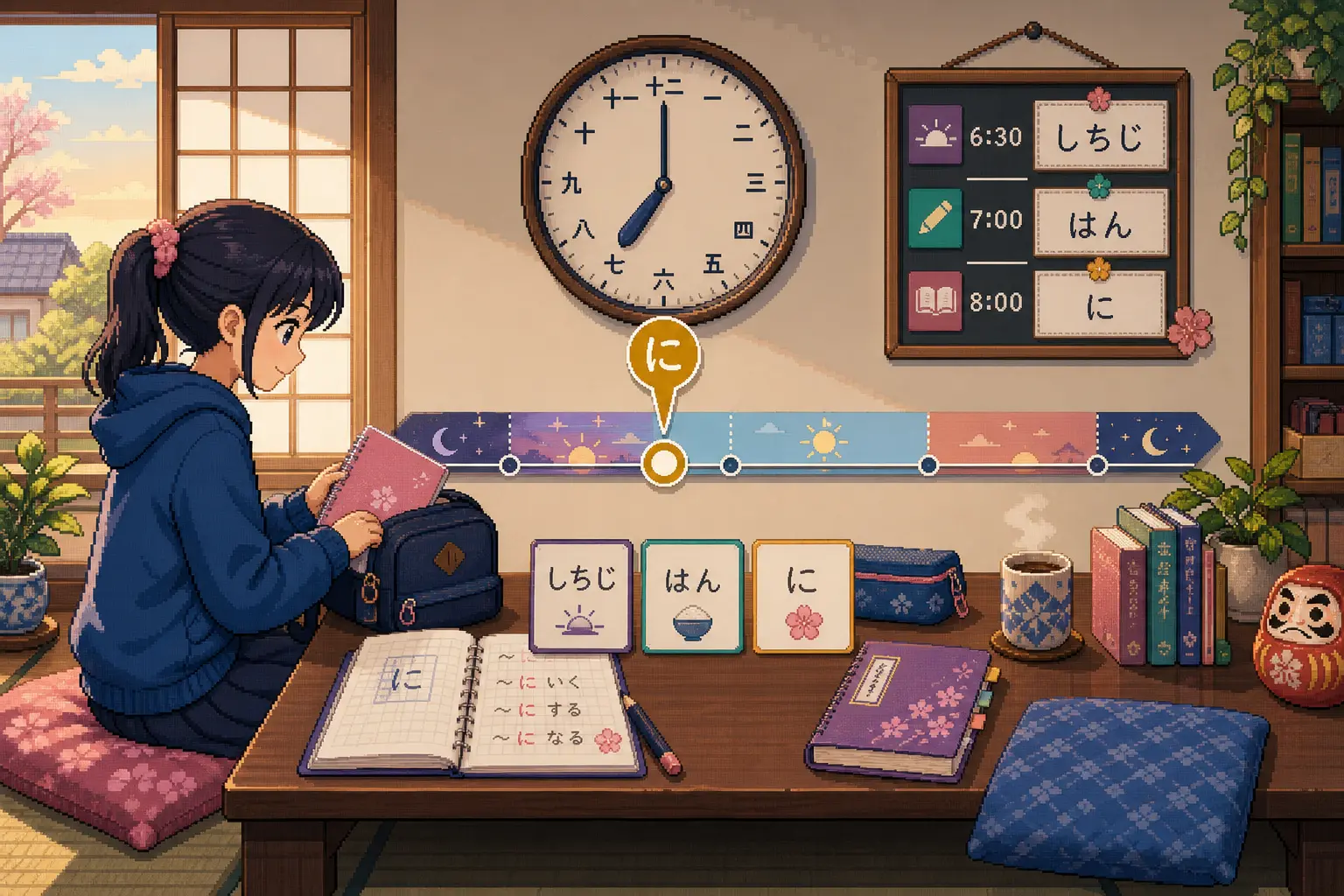
1. Telling the Hour: 〜じ (ji)
To say the hour, simply add じ (ji) to the number. Pay close attention to the irregulars!
いちじ
Timeichi-ji
1:00
にじ
Timeni-ji
2:00
さんじ
Timesan-ji
3:00
よじ
Timeyo-ji
4:00 (IRREGULAR)
ごじ
Timego-ji
5:00
ろくじ
Timeroku-ji
6:00
しちじ
Timeshichi-ji
7:00 (IRREGULAR)
はちじ
Timehachi-ji
8:00
くじ
Timeku-ji
9:00 (IRREGULAR)
じゅうじ
Timejuu-ji
10:00
じゅういちじ
Timejuu-ichi-ji
11:00
じゅうにじ
Timejuu-ni-ji
12:00
[!CAUTION]
- 4 o’clock is yo-ji (never yon-ji or shi-ji).
- 7 o’clock is shichi-ji (rarely nana-ji).
- 9 o’clock is ku-ji (never kyuu-ji).
2. Telling Minutes: 〜ふん / 〜ぷん (fun / pun)
Minutes are a bit more complex because the pronunciation changes between fun and pun based on the previous sound.
- 〜ぷん (pun): 1, 3, 4, 6, 8, 10
- 〜ふん (fun): 2, 5, 7, 9
- Half past: Use 〜じ はん (ji han).
means Expressing a specific time on the clock.
Formation
Hour + じ + Minute + ふん/ぷん
いま なんじ です か。
Ima nan-ji desu ka.
What time is it now?
ごぜん はちじ です。
Gozen hachi-ji desu.
It is 8:00 AM.
ごご さんじ じゅっぷん です。
Gogo san-ji juppun desu.
It is 3:10 PM.
じゅうじ はん です。
Juu-ji han desu.
It is 10:30.
ごぜん よじ じゅうごふん です。
Gozen yo-ji juu-go-fun desu.
It is 4:15 AM.
ろくじ ごじゅっぷん です。
Roku-ji go-juppun desu.
It is 6:50.
3. The Time Particle: に (ni)
When an action happens at a specific point in time, you must use the particle に (ni).
means At [time], I do [action].
Formation
Time + に + Verb
しちじ に おきます。
Shichi-ji ni okimasu.
I wake up at 7:00.
じゅうにじ に ごはん を たべます。
Juu-ni-ji ni gohan o tabemasu.
I eat a meal at 12:00.
じゅういちじ に ねます。
Juu-ichi-ji ni nemasu.
I go to sleep at 11:00.
[!TIP] When NOT to use に: Do not use に with relative time words like “today” (kyou), “tomorrow” (ashita), or “every day” (mainichi). Only use it for specific numbers/calendar points!
くじ に だいがく へ いきます。
Ku-ji ni daigaku e ikimasu.
I go to the university at 9:00.
どようび に パーティー が あります。
Doyoubi ni paatii ga arimasu.
There is a party on Saturday.
なんじ に きます か。
Nan-ji ni kimasu ka.
What time will you come?
4. Cultural Note: Japanese Punctuality (時間に正確)
Japan is world-famous for its punctuality. This applies to trains, business meetings, and social gatherings.
- The “5-Minute Rule”: It is often expected that you arrive 5 minutes before the scheduled time. Arriving exactly on time is sometimes considered “cutting it close.”
- Train Precision: Japanese trains are so precise that if a train is delayed by more than a minute, the company may issue a “delay certificate” (chien-shoumeisho) for employees to show their bosses.
- Social Respect: Being on time is seen as a sign of respect for the other person’s time. If you are going to be even 5 minutes late, it is polite to send a message immediately.
Conversation Practice
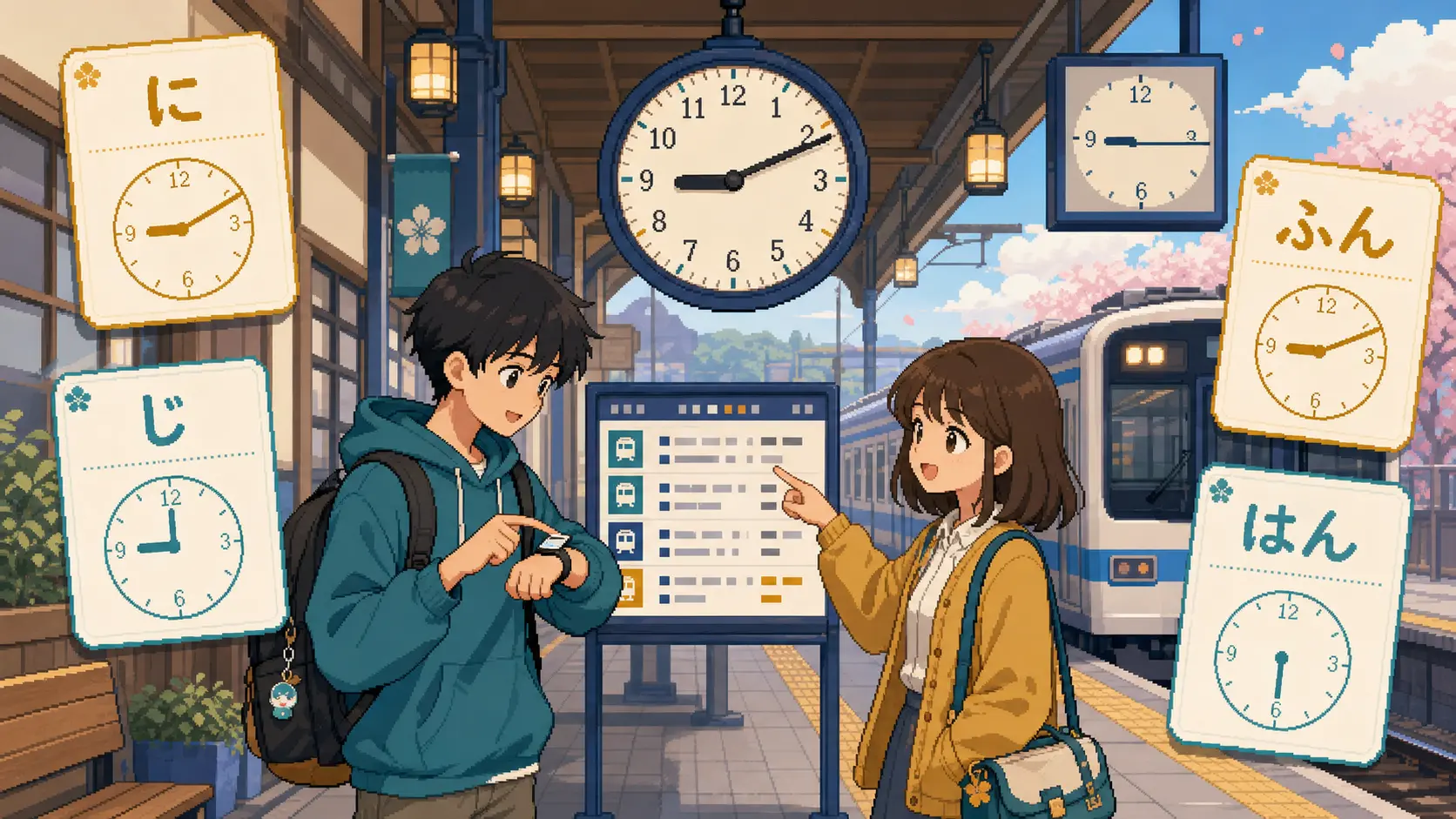
すみません、 いま なんじ です か。
Sumimasen, ima nan-ji desu ka.
Excuse me, what time is it now?
ごご よじ じゅっぷん です。
Gogo yo-ji juppun desu.
It is 4:10 PM.
そうですか。 なんじ に かえります か。
Sou desu ka. Nan-ji ni kaerimasu ka.
I see. What time will you go home?
ろくじ はん に かえります。
Roku-ji han ni kaerimasu.
I will go home at 6:30.
でんしゃ は くじ じゅうごふん です。
Densha wa ku-ji juu-go-fun desu.
The train is at 9:15.
あ! いま くじ じゅっぷん です!
A! Ima ku-ji juppun desu!
Ah! It's 9:10 now!
いそいで ください!
Isoide kudasai!
Please hurry!
はい、 ありがとうございます!
Hai, arigatou gozaimasu!
Yes, thank you very much!
Chapter Summary
- 1Hours are Number + じ (ji). Remember exceptions: 4 (yo-ji), 7 (shichi-ji), 9 (ku-ji).
- 2Minutes are Number + ふん/ぷん (fun/pun). 'Half past' is 'han'.
- 3Use 'gozen' for AM and 'gogo' for PM BEFORE the time.
- 4The particle に (ni) marks the specific time an action happens (e.g., at 7:00).
- 5Punctuality is a core value in Japanese culture; try to arrive 5 minutes early!
Knowledge Check
Test your clock-reading skills!
How do you say 4:00 in Japanese?
Practice Quiz
How do you say 4:00 in Japanese?
- yon-ji
- shi-ji
- yo-ji
- yotsu-ji
What is the correct reading for 9:00?
- kyuu-ji
- ku-ji
- kokono-ji
- nana-ji
Which particle means 'at' when used with time?
- は
- を
- に
- の
How do you say 'half past' (e.g., 3:30)?
- san-ji juu-bun
- san-ji han
- san-ji han-pun
- san-ji go-fun
Translate: 'I wake up at 7:00.'
- shichi-ji ni okimasu
- nana-ji ni okimasu
- shichi-ji o okimasu
- shichi-ji wa okimasu
Does 'kyou' (today) take the particle 'ni'?
- Yes
- No
What does 'gozen' mean?
- AM
- PM
- Noon
- Midnight
How do you say 10:10?
- juu-ji juu-fun
- juu-ji juppun
- juu-ji juu-bun
- juu-ji pun
Translate: 'Gogo san-ji ni ikimasu.'
- I go at 3:00 AM.
- I go at 3:00 PM.
- I go with 3 people.
- I go to 3 places.
Which is the correct 7:00 reading?
- nana-ji
- shichi-ji
- shichi-nichi
- nana-nichi
What is 'han' in 'juu-ni-ji han'?
- 12:00
- 12:15
- 12:30
- 12:45
If a meeting is at 10:00, what time should you arrive according to Japanese etiquette?
- 10:05
- 10:00 exactly
- 9:55
- Anytime before 10:15
Fill in the blank: 'Mainichi shichi-ji _____ okimasu.'
- に
- は
- を
- の
How do you ask 'What time is it now?'
- Ima nan-ji desu ka.
- Ima nan-nichi desu ka.
- Ima nani desu ka.
- Ima dare desu ka.
Translate: 'Roku-ji go-juppun'
- 6:05
- 6:15
- 6:50
- 5:06
Which of the following time words does NOT use the particle に (ni)?
- あした
- ろくじ
- どようび
- くじ はん
How do you say '3 minutes' in Japanese?
- さんふん
- さんぷん
- さんぶん
- みっつ
How do you say '5 minutes' in Japanese?
- ごぷん
- いつぷん
- ごふん
- いつふん
How do you say '8:00 AM' in Japanese?
- ごぜん はちじ
- ごご はちじ
- はちじ ごぜん
- あさ はちじ ごご
Which sentence correctly says 'I will go to sleep at 11:00'?
- じゅういちじ に ねます。
- じゅういちじ を ねます。
- じゅういちじ で ねます。
- じゅういちじ は ねます。
Applied review
Use what you learned
Focus: Time and に. Try the task before revealing the model.
Produce the Japanese sentence, then compare it with the model answer.
1.Say “The lesson starts at half past nine.”
Time and に in context
N5 mini-reading
- Does the speaker arrive when the library opens?