Pronouns & Particle も
Learning objectives
- Learn Japanese personal pronouns and when to use them.
- Master demonstrative pronouns (Ko-So-A-Do system).
- Use the particle も (mo) to express 'also' or 'too'.
- Understand the use of Japanese honorifics like -san, -kun, and -chan.
In Japanese, we often avoid using “I” or “You” once the context is established. However, knowing when and how to use pronouns is essential for clear communication. In this chapter, we will also learn the Ko-So-A-Do system for pointing at objects and the particle も, which allows you to add information to your sentences.
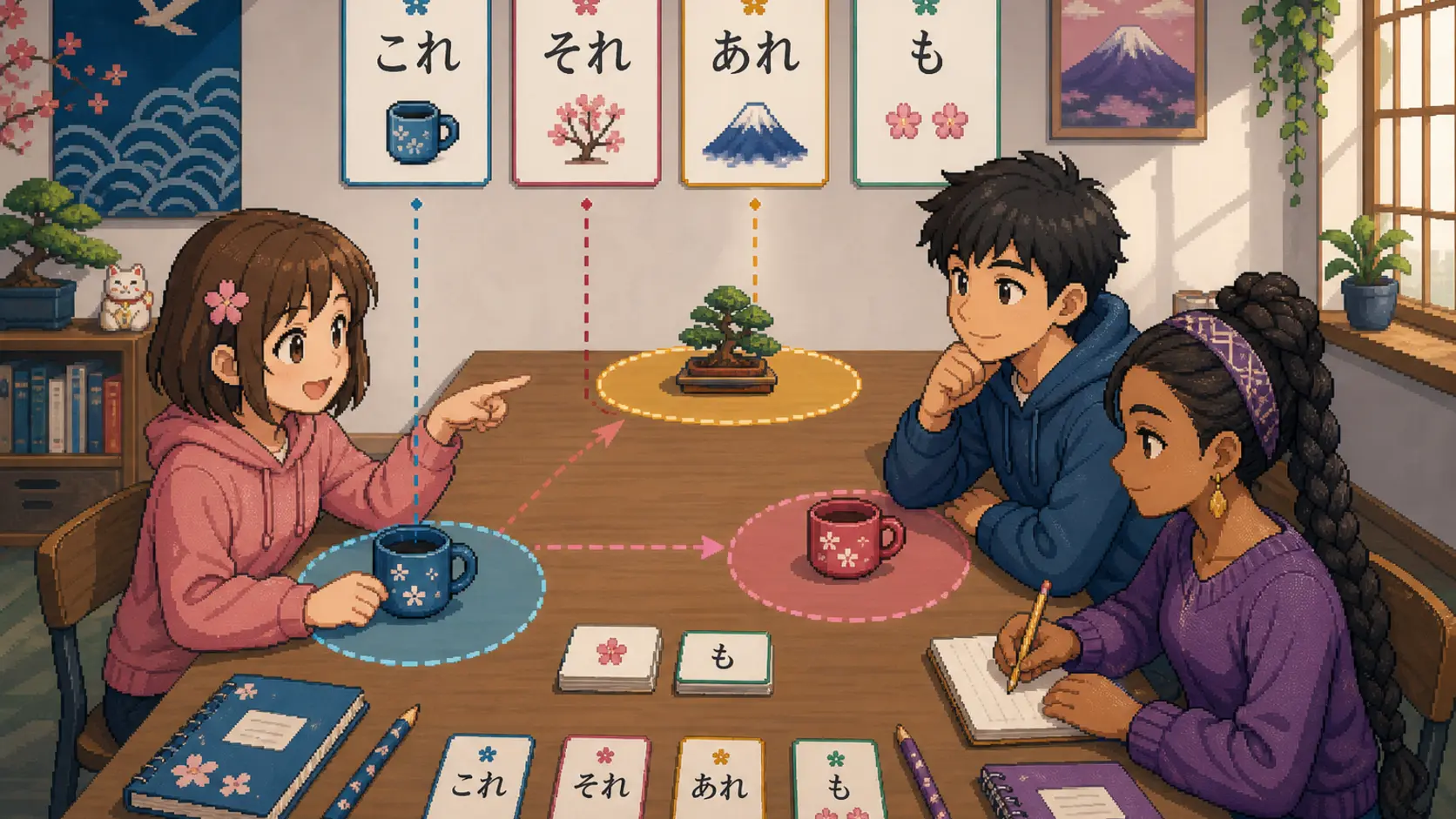
1. Personal Pronouns
While English uses pronouns constantly, Japanese often omits them if it is obvious who is speaking.
わたし
Pronounwatashi
I / Me (Standard)
あなた
Pronounanata
You (Use sparingly)
かれ
Pronounkare
He / Boyfriend
かのじょ
Pronounkanojo
She / Girlfriend
わたしたち
Pronounwatashitachi
We
[!TIP] Instead of saying “You” (anata), it is much more polite and common in Japan to refer to someone by their Name + Honorific (e.g., Tanaka-san).
わたし は 日本語 の 学生 です。
Watashi wa Nihongo no gakusei desu.
I am a student of the Japanese language.
かれ は わたしたち の 先生 です。
Kare wa watashitachi no sensei desu.
He is our teacher.
あなた は 日本人 です か。
Anata wa Nihonjin desu ka.
Are you Japanese?
2. Demonstrative Pronouns (Ko-So-A-Do)
Japanese uses a systematic way to point at things based on their distance from the speaker and listener.
- これ (Kore): This (Near the speaker)
- それ (Sore): That (Near the listener)
- あれ (Are): That over there (Far from both)
- どれ (Dore): Which one? (Question)
means Identifying objects based on distance.
Formation
Pronoun + は + Noun + です
これ は わたし の 本 です。
Kore wa watashi no hon desu.
This is my book.
それ は なん です か。
Sore wa nan desu ka.
What is that (near you)?
あれ は 先生 の 車 です。
Are wa sensei no kuruma desu.
That over there is the teacher's car.
3. The “Also” Particle: も (mo)
The particle も (mo) means “also” or “too”. It is unique because it replaces the particles は (wa), が (ga), and を (o).
means Expresses 'also' or 'too'.
Formation
Noun + も (Replaces は, が, を)
わたし は 学生 です。 アリさん も 学生 です。
Watashi wa gakusei desu. Ari-san mo gakusei desu.
I am a student. Ali is ALSO a student.
これ は ペン です。 それ も ペン です。
Kore wa pen desu. Sore mo pen desu.
This is a pen. That is also a pen.
りんご を たべます。 バナナ も たべます。
Ringo o tabemasu. Banana mo tabemasu.
I eat apples. I also eat bananas.
4. Cultural Note: Japanese Names & Honorifics
In Japan, you rarely call someone by their first name unless you are very close. Usually, you use their Family Name + Honorific.
- -san (さん): The most common honorific, equivalent to Mr., Ms., or Mrs. Use it for almost everyone.
- -kun (君): Typically used for boys or by superiors to subordinates.
- -chan (ちゃん): A cute honorific used for children, female friends, or pets.
- -sama (様): Extremely formal, used for customers or deities.
Never use an honorific on your own name! It sounds very arrogant.
Practical Conversations
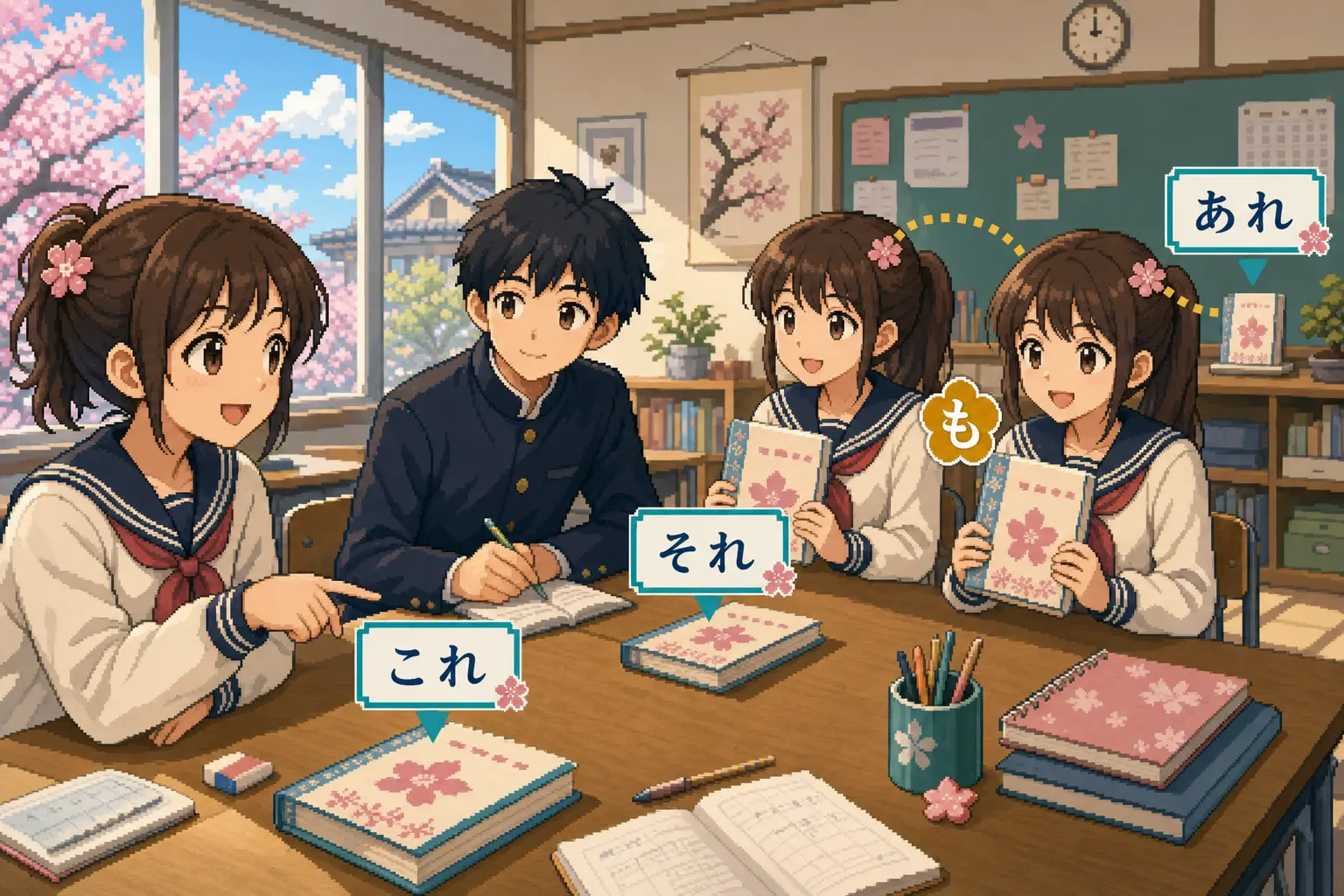
すみません、それ は あなた の 本 です か。
Sumimasen, sore wa anata no hon desu ka.
Excuse me, is that your book?
はい、これ は わたし の 本 です。
Hai, kore wa watashi no hon desu.
Yes, this is my book.
これ も あなた の です か。
Kore mo anata no desu ka.
Is this (one) also yours?
いいえ、それ は わたし の ではありません。 あれ は やまださん の です。
Iie, sore wa watashi no dewa arimasen. Are wa Yamada-san no desu.
No, that is not mine. That one over there is Mr. Yamada's.
はじめまして。 さとう です。
Hajimemashite. Satou desu.
Nice to meet you. I am Sato.
はじめまして。 けん です。 かのじょ は アンナさん です。
Hajimemashite. Ken desu. Kanojo wa Anna-san desu.
Nice to meet you. I am Ken. She is Anna.
アンナさん も 学生 です か。
Anna-san mo gakusei desu ka.
Is Anna also a student?
はい、わたしたち は 学生 です。
Hai, watashitachi wa gakusei desu.
Yes, we are students.
Chapter Summary
- 1Personal pronouns like わたし (I) are used, but often omitted when context is clear.
- 2Use 'Family Name + さん' instead of 'You' (anata) to be polite.
- 3The Ko-So-A-Do system (これ, それ, あれ) helps identify objects based on distance.
- 4The particle も (mo) means 'also' or 'too' and replaces は, が, and を.
- 5Never use honorifics like -san on your own name.
Knowledge Check
Test your understanding of pronouns and the particle も!
Which pronoun is the most standard way to say 'I' or 'Me'?
Practice Quiz
Which pronoun is the most standard way to say 'I' or 'Me'?
- あなた
- わたし
- かれ
- わたしたち
Which word means 'That (near the listener)'?
- これ
- それ
- あれ
- どれ
Which particle means 'also' or 'too'?
- は
- の
- も
- を
Translate: 'わたし も 学生 です。'
- I am a student
- I am also a student
- My student
- Are you a student?
Which honorific is the most versatile and safe to use for almost anyone?
- -kun
- -chan
- -san
- -sama
What does the particle も replace when used in a sentence?
- の
- に
- は, が, and を
- と
How do you say 'We' in Japanese?
- わたし
- あなたたち
- わたしたち
- かれら
Which word is used to point at something far from both the speaker and listener?
- これ
- それ
- あれ
- どれ
True or False: You should add '-san' to your own name when introducing yourself.
- True
- False
What does 'かのじょ' mean?
- He
- She / Girlfriend
- We
- You
To say 'This is ALSO your book', which particle fills the blank? これ ____ あなた の 本 です。
- は
- も
- の
- を
Which demonstrative is used to ask 'Which one?'
- これ
- それ
- あれ
- どれ
Translate: 'Tanaka-san mo Nihonjin desu.'
- Mr. Tanaka is Japanese.
- Is Mr. Tanaka Japanese?
- Mr. Tanaka is also Japanese.
- I am also Japanese.
What is the most polite way to address a customer?
- -kun
- -san
- -sama
- -chan
In the Ko-So-A-Do system, which prefix refers to the speaker's area?
- Ko-
- So-
- A-
- Do-
Which demonstrative pronoun refers to an object far from both the speaker and the listener?
- これ
- それ
- あれ
- どれ
Which particle does も directly replace when saying 'I also drink water'?
- を
- に
- で
- へ
Which honorific is the standard, polite title suitable for most acquaintances and colleagues?
- -chan
- -kun
- -san
- -sama
What is the standard, gender-neutral personal pronoun for 'I / me' in polite Japanese?
- わたし
- ぼく
- おれ
- あなた
How do you ask 'Which one is your pen?'
- どれ が あなた の ペン です か。
- これ は あなた の ペン です か。
- それ は あなた の ペン です か。
- あれ は あなた の ペン です か。
Applied review
Use what you learned
Focus: Pronouns and も. Try the task before revealing the model.
Produce the Japanese sentence, then compare it with the model answer.
1.Say “I am a student too.”
Pronouns and も in context
N5 mini-reading
- What do Tanaka and Yamada have in common?